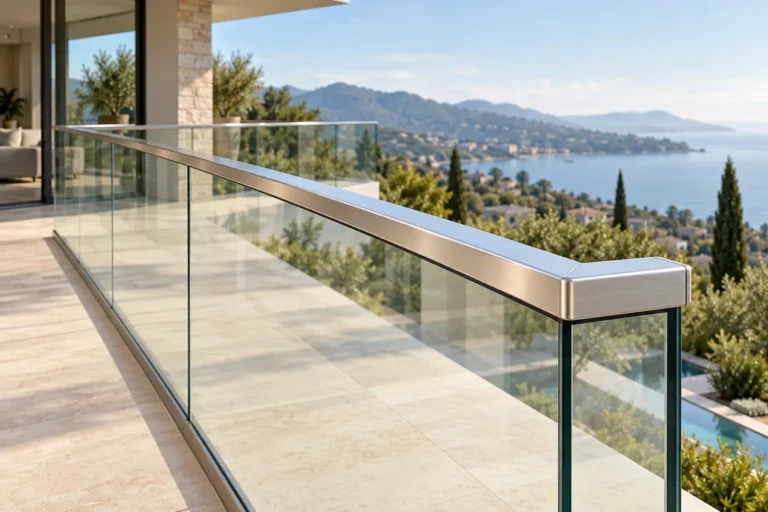
Glass clamps per panel is the first number a fabricator needs, yet most product pages skip it. The real answer depends on panel width, glass thickness, clamp size and the load the guard must carry. Get it wrong and the panel rattles, the rubber creeps, or an inspector rejects the job. At UNIKIM we make glass clamps in our own Ningbo factory, so this guide explains how we size a layout before a quote.
What a glass clamp does in a railing panel
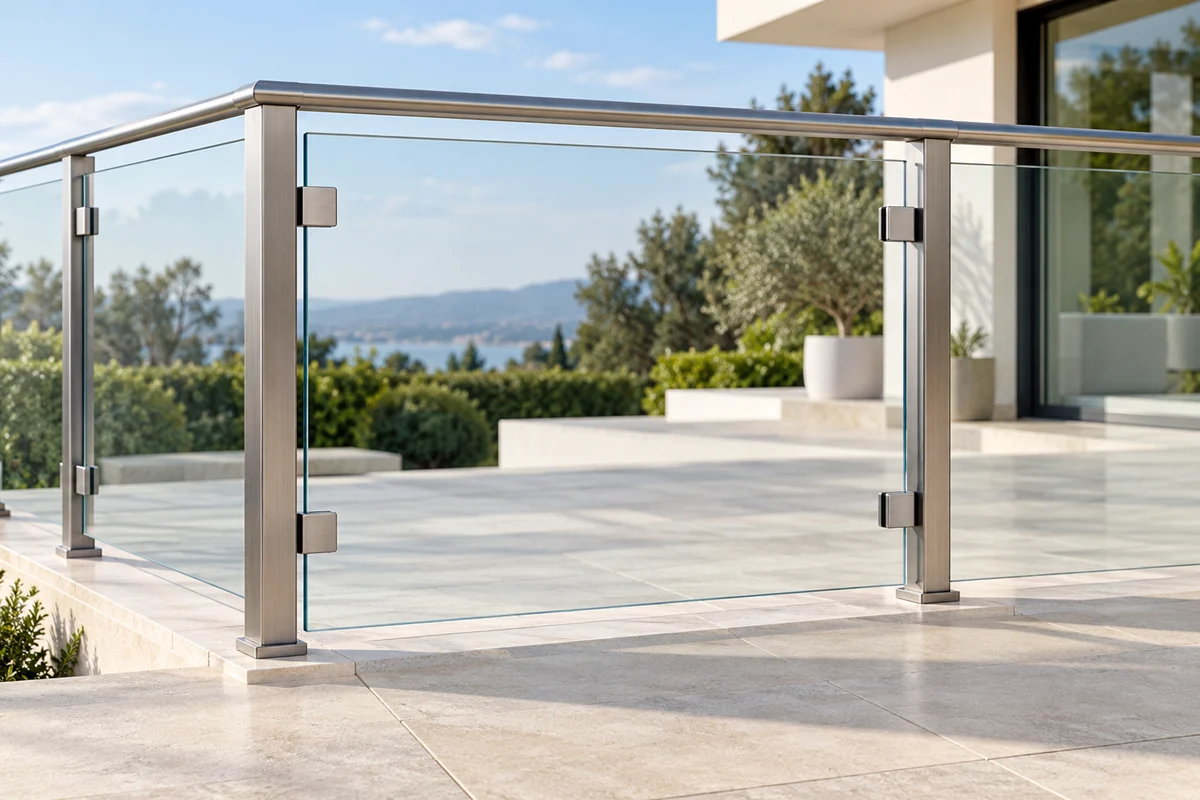
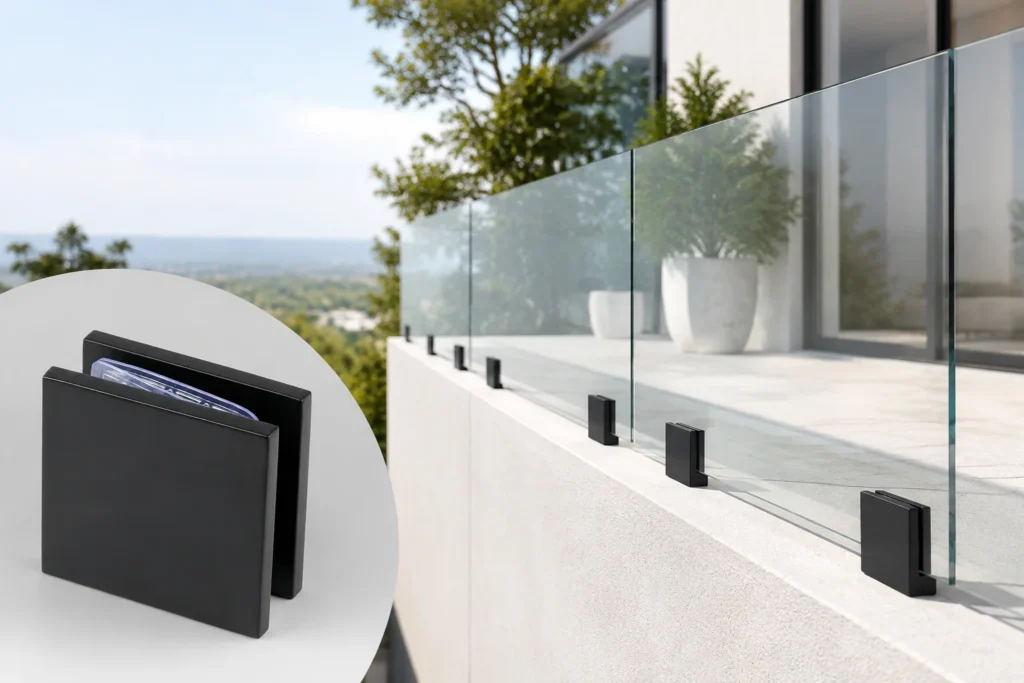
A glass clamp is a small stainless steel block that grips the glass edge through rubber inserts. It bolts to a round or flat post, so the panel becomes an infill between two posts. In practice, the clamp never touches the glass directly, because the rubber spreads the pressure and protects the edge.
Most clamps hold the glass by friction. Some models add a security pin through a drilled hole, while others use a baffle plate so the panel cannot slide out. Our square glass clamps MOD 2021 and MOD 2023 are examples of that second type.
Because each clamp only holds a short length of edge, the number and position of clamps decide how the panel behaves. That is why glass clamps per panel matters more than the clamp price.
How many glass clamps per panel: the usual starting point
For a standard infill panel between two posts, the usual starting point is four clamps: two on each side. One pair sits near the top of the panel and one pair near the bottom. As a result, the glass is held at four points and cannot rotate or rock.
However, four clamps is a starting point, not a rule. Wider or heavier panels often need a third clamp per side. In addition, stair panels need the clamps set on the rake, so the top and bottom pairs sit at different heights on each post.
Here is how we usually think about glass clamps per panel on a quote:
| Situation | Typical clamps per panel | Why |
|---|---|---|
| Standard infill panel with a top rail | 4 (2 per side) | The top rail takes the guard load; clamps hold the infill |
| Wide or heavy panel | 6 (3 per side) | Shorter span between clamps, less load per clamp |
| Stair panel | 4–6, set on the rake | Clamps follow the stair angle |
| Panel joined to another panel (no post) | 2–3 glass-to-glass clamps per joint | The joint replaces a post |
These are planning figures for a quote. The final layout always comes from the clamp maker’s data and the project engineer.
Why loads decide the clamp count
Building codes set the loads, and the clamp layout must carry them. Under the IBC, guards must resist 50 pounds per linear foot and a 200-pound concentrated load, while infill components must resist a 50-pound concentrated load. You can read the wording in IBC Section 1607.9 on loads for handrails and guards.
Glass adds its own rules. IBC Section 2407 on glass in handrails and guards requires a factor of safety of four, and it requires laminated glass in most cases. Because of that, a clamp layout that “feels” solid in the workshop may still fail the calculation.
In practice, the top rail matters most. When a handrail or top rail carries the 200-pound load, the glass panel only acts as infill. Therefore the clamps only need to carry the smaller infill load, and four clamps per panel is often enough. Without a top rail, the glass becomes the guard itself, which is a different design.
Glass clamps per panel by panel width
Panel width is the biggest single factor. A wide panel has a longer free edge and more weight, so each clamp carries more. For that reason, our clamp data lists a panel width range where the maker has one.
Our heavy-duty square glass clamp 70 × 55 mm (MOD 2024) is rated for panels 500–1,600 mm wide and 10–17.52 mm glass. Similarly, the rectangular glass clamp 57 × 45 mm (MOD 2026) suits panels up to 1,800 mm in 8–12.76 mm glass.
Smaller clamps work best on narrower panels and thinner glass. For example, a 45 × 45 mm square clamp holds 6–10.76 mm glass, which suits indoor stairs and landings. Above that size, we normally move to a 55 × 55 mm or larger clamp.
As a simple rule, if the panel is near the top of a clamp’s width range, plan an extra clamp per side. That keeps each clamp well inside its working load.
Matching clamp size to glass thickness
The clamp must fit the glass exactly, because the rubber insert is cut for one thickness. A clamp for 10.76 mm laminated glass will not hold 12.76 mm glass safely. So the glass thickness must be fixed before the clamp order.
Here is how our main clamp sizes line up with glass thickness:
| Clamp | Size | Glass (single / laminated) | Typical use |
|---|---|---|---|
| MOD 2010 D-shape | 50 × 40 mm | 6–10 / 6.76–10.76 mm | Indoor stairs, light balustrades |
| MOD 2011 D-shape | 63 × 45 mm | 6–12 / 6.76–12.76 mm | Indoor and outdoor balustrades |
| MOD 2025 square | 45 × 45 mm | 6–10 / 6.76–10.76 mm | Indoor stairs |
| MOD 2022 square | 55 × 55 mm | 6–12 / 6.76–12.76 mm | Balconies, landings |
| MOD 2026 rectangular | 57 × 45 mm | 8–12 / 8.76–12.76 mm | Wide panels up to 1,800 mm |
| MOD 2024 square | 70 × 55 mm | 10–12 / 10.76–17.52 mm | Heavy laminated glass |
Every clamp in the table fits a flat surface or a round tube from Ø33.7 to 50.8 mm. You can compare all of them in our glass clamps category.
Spacing and position on the post
Once you know the glass clamps per panel, spacing comes next. The aim is to hold the panel close to its corners without stressing the glass edge. Because every glass supplier and engineer has its own edge rules, we follow the project drawing rather than a fixed number.
Still, a few points apply to almost every layout. First, keep the top and bottom pairs at the same height on both posts, unless the panel is on a stair. Second, leave a small gap between the glass and the post, so the glass never touches steel. Third, keep the bottom edge clear of the floor to allow drainage and cleaning.
On stairs, set the clamps parallel to the stair pitch. The panel is usually a parallelogram, so the clamps on the low post sit lower than those on the high post. Our guide to installing frameless glass railing clamps shows the fitting steps.

Corners and panels without posts
Sometimes there is no post at a joint. Then glass-to-glass clamps replace the post and carry the panels together. In that case, count the clamps per joint as well as the glass clamps per panel.
A straight joint uses a 180° clamp, while a corner uses a 90° clamp. For example, our 90° glass-to-glass corner clamp (MOD 2051) holds 6–12.76 mm glass without a corner post. Most joints use two clamps, and tall or heavy panels use three.
Glass-to-glass layouts need extra care. Because there is no post, the code rules on top rails and laminated glass matter even more. So ask your engineer early, before the glass is cut.
Rubber inserts, finishes and outdoor use
Rubber inserts are small, yet they decide how the clamp grips. Each insert is made for one glass thickness, and spare sets are worth ordering with the clamps. Our glass clamp rubber inserts fit clamps MOD 2010–2031, 2050 and 2051, for 6–17.52 mm glass.
Material matters outdoors. Grade 304 stainless steel suits dry indoor areas, while 316 resists chlorides near pools and the sea. For more detail, see our article on 304 vs 316 stainless steel. In addition, most of our clamps come brushed, polished, black or white.
Worked example: glass clamps per panel on a balcony
Here is a typical balcony job, so you can see the logic step by step. The balcony is 6 m long, with round posts of Ø42.4 mm. Each panel is about 1,200 mm wide and 900 mm high, with 12.76 mm laminated glass and a stainless top rail.
First, we check the clamp. A 55 × 55 mm square clamp holds 6.76–12.76 mm laminated glass and fits a Ø42.4 mm tube, so it suits this glass. Next, we look at the panel. At 1,200 mm wide with a top rail, the glass acts as infill, so four glass clamps per panel is the normal start.
Then we check the exposure. The site is near the coast, so we specify 316 stainless steel instead of 304. Finally, we count the job. Five panels at four clamps each gives 20 clamps, plus spare rubber inserts for site breakage.
If the same balcony had no top rail, the answer would change. In that case, the engineer would treat each panel as the guard, and the design would follow the stricter glass rules. As a result, the clamp model, the clamp count and even the system type could change.
Checklist: glass clamps per panel before you order
Before you confirm glass clamps per panel with a supplier, check these points once more:
- Panel width and height for every panel, including stair panels
- Glass type and exact thickness, single or laminated
- Post shape and diameter, or a flat surface
- Top rail or no top rail
- Indoor, outdoor, pool or coastal site, which decides 304 or 316
- Finish: brushed, polished, black or white
- Spare rubber inserts for each glass thickness
With these seven points, a supplier can confirm glass clamps per panel quickly and avoid a second quote round.
Cost: what changes the price of a clamp layout
The clamp count drives the cost, so a careful layout saves money. However, cutting clamps to save cost is a false economy if the panel then fails inspection.
Four things change the price most. First, the clamp size and grade, because a 70 × 55 mm clamp in 316 costs more than a 45 × 45 mm clamp in 304. Second, the finish, since black, white or polished clamps take extra steps. Third, the number of clamps per panel across the whole job. Fourth, the order volume and packing.
When you ask a supplier for a quote, send the panel sizes, glass thickness, post diameter and site location. Then the supplier can check glass clamps per panel and the right grade in one step.
Why buy glass clamps from a manufacturer
A manufacturer can match the clamp, rubber and post size because it makes all three. In our case, UNIKIM has over 20 years of manufacturing experience in Ningbo, China. We make clamps in 304 and 316 stainless steel and supply OEM and wholesale orders.
Buying direct also helps with mixed orders. For example, clamps, posts, end caps and handrails can ship together in one container. You can also see our range on our store on Made-in-China.
FAQ
For a standard balcony panel between two posts with a top rail, four glass clamps per panel is the usual starting point: two on each side. Wider panels, thick laminated glass or exposed sites often need six. The final count depends on the clamp’s rated panel width and the loads your engineer applies under the local code.
It depends on the clamp. Small 45 × 45 mm clamps suit narrow indoor panels, while larger clamps carry wider glass. For example, our 70 × 55 mm clamp MOD 2024 is rated for panels 500–1,600 mm wide, and our 57 × 45 mm clamp MOD 2026 suits panels up to 1,800 mm. Always check the glass clamps per panel against the maker’s data.
Two clamps per panel is rarely enough for a guard, because the glass can rotate around the two points. Most layouts use at least two clamps on each side, so four in total. Two clamps can work for small, non-structural screens, but not for a balcony or stair guard that must meet building code loads.
Many glass clamp railings use a top rail or handrail, because the code treats the glass as infill when a rail carries the main load. Without a top rail, the glass becomes the guard, and the IBC sets stricter rules for laminated glass and testing. As a result, glass clamps per panel and the top rail are usually designed together.
Most glass clamps hold 6–12.76 mm glass, and heavy-duty models hold up to 17.52 mm laminated glass. The rubber insert must match the exact thickness. Many codes require laminated safety glass in guards, so 10.76 or 12.76 mm laminated glass is common. Check glass clamps per panel again whenever the glass thickness changes.
Summary
Four glass clamps per panel, two on each side, is the usual starting point for an infill panel with a top rail. From there, panel width, glass thickness, stairs and joints without posts can push the count to six or more. Because codes set real loads and a factor of safety of four for glass, the final layout should always come from the clamp data and an engineer.
UNIKIM makes square, D-shape, round and glass-to-glass clamps in 304 and 316 stainless steel, with matching rubber for every thickness. Send us your panel sizes and glass, and we will check the clamp count and return a quote. Contact UNIKIM for a quotation.