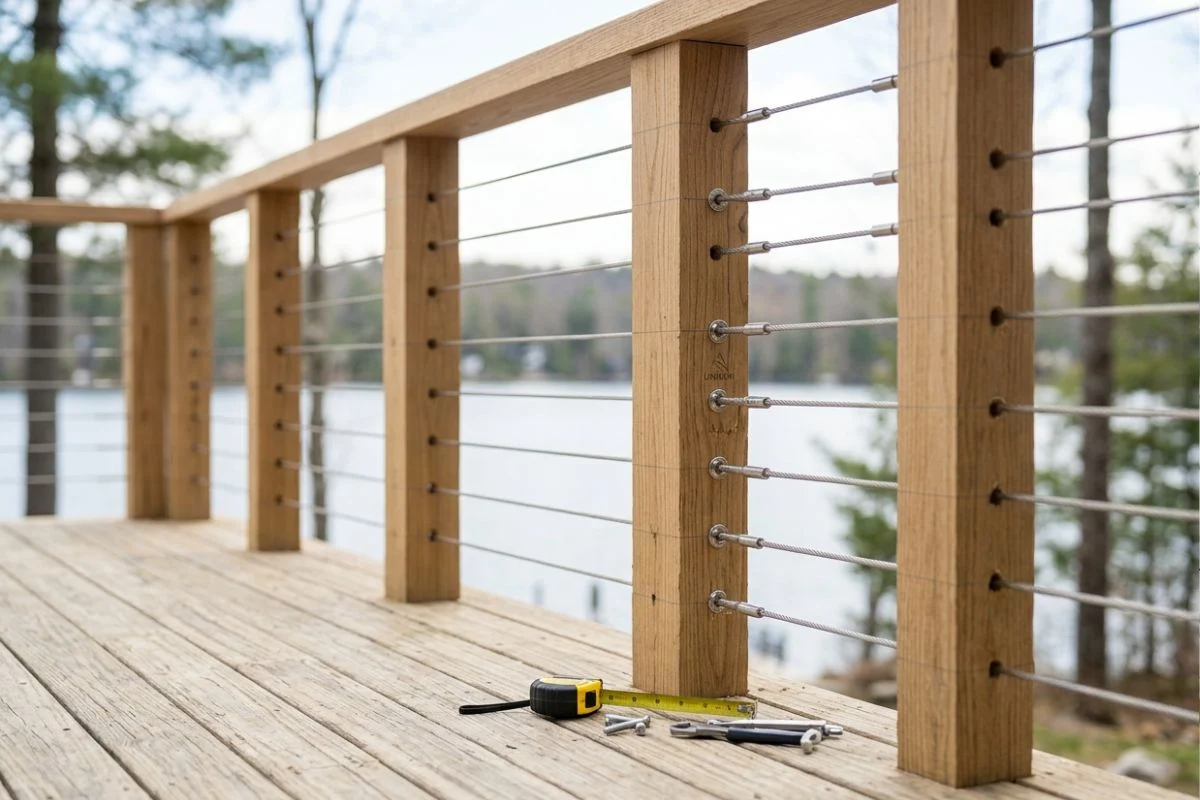
Cable railing with wood posts has become one of the most popular choices for modern decks and outdoor spaces. It combines clean architectural lines with natural warmth, making it suitable for both rustic and contemporary homes.
However, the design appeal is only one part of the system. The other critical factor is compliance. Every cable railing with wood posts installation must meet strict building regulations to ensure safety, structural strength, and long-term durability.
These rules are not optional. They come from widely adopted standards such as the IRC (International Residential Code) and IBC (International Building Code). These codes define how high railings must be, how far cables can space apart, how much they can deflect, and how strong posts must be.
In this guide, we break down everything you need to know about cable railing building code, including height requirements, spacing rules, deflection limits, and inspection standards. The goal is simple: help you build a safe, compliant, and visually clean system using cable railing with wood posts.
Why Building Code Compliance Matters
Building codes exist to prevent falls and structural failures. A deck railing is not decorative—it is a life-safety system.
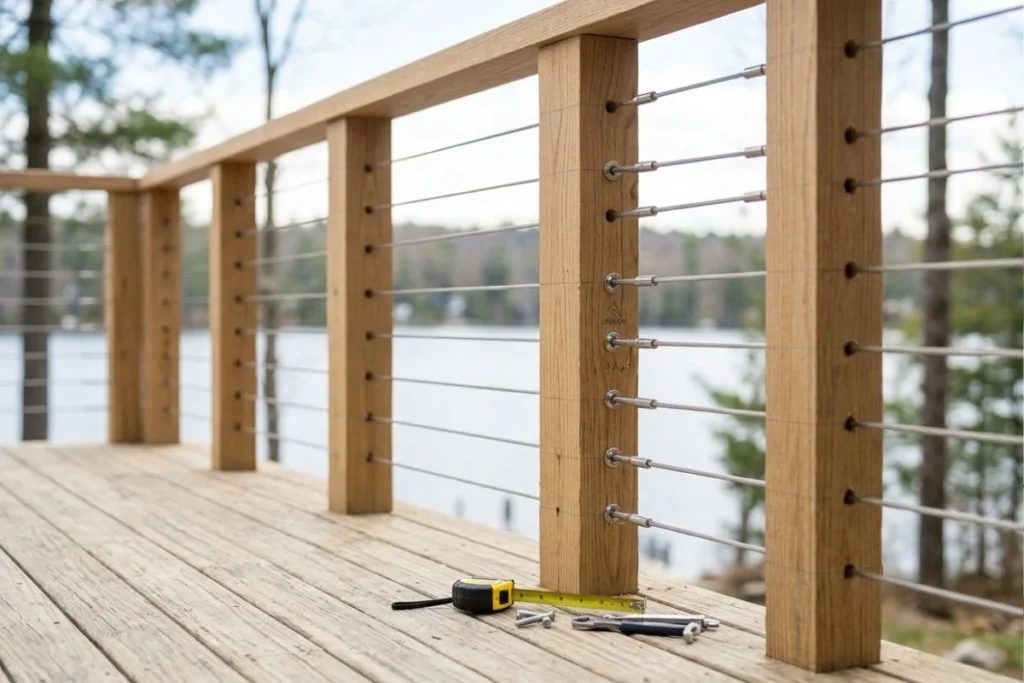
For cable railing with wood posts, compliance becomes even more important because the system uses tension instead of solid infill. That tension introduces movement, which must remain within safe limits.
Authorities like the International Code Council (ICC) define guardrail safety rules, including the famous 4-inch sphere rule, which ensures children cannot pass through railing openings.
Reference: https://codes.iccsafe.org
A poorly designed cable railing with wood posts system may look strong but fail under pressure, inspection, or long-term use.
Cable Railing Height Requirements
Height is one of the first checks during inspection for any cable railing with wood posts system.
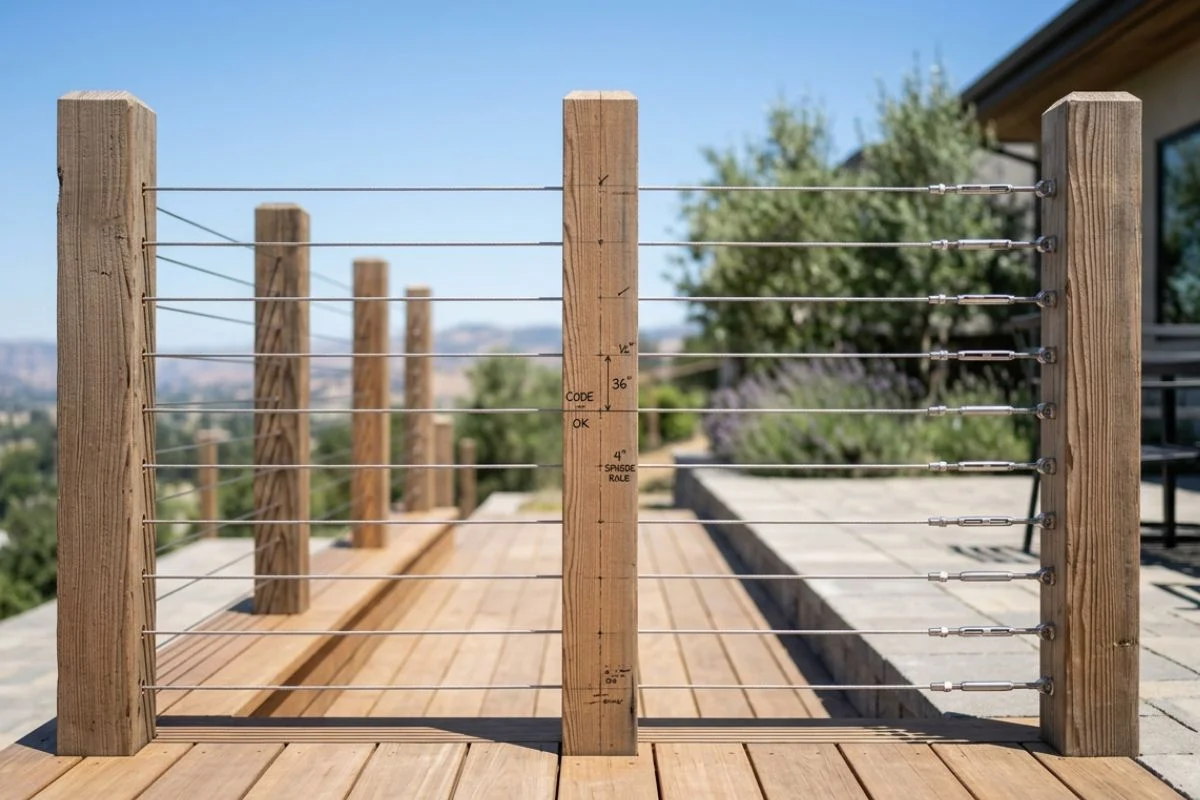
Residential Deck Code (IRC – 36 inches minimum)
For most residential applications under the IRC code, the minimum railing height is:
- 36 inches (91 cm) for decks, porches, and balconies
This applies to most cable railing with wood posts installations in single-family homes.
If your deck is higher than 30 inches above ground, this requirement becomes mandatory.
Commercial Code (IBC – 42 inches minimum)
For commercial buildings or multi-family structures under IBC cable railing standards, the minimum height is:
- 42 inches (107 cm)
This higher requirement increases safety in public spaces where traffic is heavier.
Key Insight
Even if your cable railing with wood posts design looks balanced at 34–35 inches, it will fail inspection if it does not meet minimum height.
Cable Spacing — The 4-Inch Sphere Rule
The most important rule in railing design is the 4-inch sphere rule.
This rule states that:
A 4-inch diameter sphere must not be able to pass through any opening in the railing system.
This directly affects cable railing spacing in a cable railing with wood posts system.
What it means in practice
- Cable spacing must prevent sagging under pressure
- Post spacing must limit cable deflection
- Tension must be high enough to maintain consistent gaps
Even if cables are installed at perfect spacing, they can still fail inspection if they deflect too much when pressure is applied.
Reference: https://en.wikipedia.org/wiki/Baluster
In real-world cable railing with wood posts systems, installers typically use tighter spacing than traditional balusters to pass this test.
Cable Deflection Limits
Cable deflection is one of the most misunderstood parts of cable railing building code.
Deflection refers to how much the cable bends when force is applied.
Code expectation
While codes do not always define exact deflection numbers, inspectors test this:
- 4-inch sphere test under pressure
- Mid-span push test (hand pressure)
If cables move too far, the system fails—even if spacing looks correct.
Why wood posts matter
In cable railing with wood posts, the posts absorb tension. If posts are weak or poorly spaced, deflection increases.
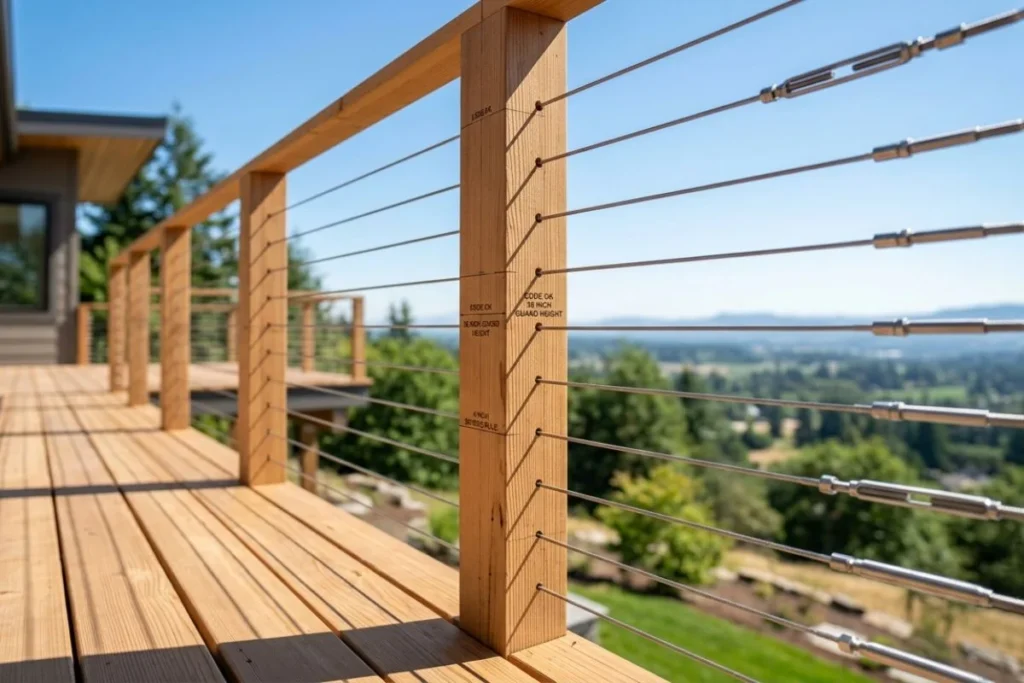
Common causes of failure:
- 4×4 posts spaced too far apart
- Insufficient end post reinforcement
- Under-tensioned cables
- Softwood species with low stiffness
Strong hardwood or engineered posts significantly improve compliance.
Post Spacing Requirements
Post spacing directly affects both safety and appearance in cable railing with wood posts systems.
Typical spacing guidelines
Although not always explicitly defined in code, industry standards suggest:
- 3 to 4 feet spacing for best performance
- Maximum spacing depends on cable diameter and tension
Why spacing matters
Long spans increase:
- Cable sag
- Deflection under pressure
- Risk of failing the 4-inch rule
Engineering insight
Shorter post spacing reduces stress on:
- End posts
- Corner posts
- Lag screw terminals
This is critical in cable railing with wood posts systems because wood is more flexible than steel.
End Post and Corner Post Strength
End posts carry the highest load in any cable railing with wood posts installation.
They resist all cable tension forces pulling in one direction.
Key requirements
- Must be structurally anchored to deck framing
- Often require blocking or reinforcement
- Preferably 6×6 wood posts for high-tension systems
Corner posts are even more complex because they handle directional force changes.
Poor end post design is the number one reason cable railing building code systems fail inspection.
Cable Tension Requirements (200–300 lbs)
Proper tension is critical in cable railing with wood posts systems.
Standard tension range
Most systems aim for:
- 200–300 lbs of tension per cable
This ensures:
- Minimal deflection
- Compliance with 4-inch rule
- Structural stability
Too little tension leads to sagging. Too much tension can:
- Bend wood posts inward
- Crack wood around fittings
- Damage lag screw terminals
This balance is essential for safe cable railing with wood posts performance.
Cable Railing Building Code Differences by Region (IRC / IBC / NZS)
Different regions interpret railing safety slightly differently.
IRC (United States Residential Code)
- 36-inch minimum height
- 4-inch sphere rule
- Load resistance requirements
IBC (Commercial Code)
- 42-inch minimum height
- Higher load requirements
- Stricter inspection standards
NZS (New Zealand Standards)
- Similar safety principles
- Additional focus on wind load
- More strict deflection control
Regardless of region, cable railing with wood posts must always meet local authority requirements before approval.
How to Pass a Building Inspection
Passing inspection for cable railing with wood posts depends on preparation.
Key inspection focus areas
Inspectors typically check:
- Railing height accuracy
- Post attachment strength
- Cable spacing consistency
- 4-inch sphere rule compliance
- Structural stability under pressure
Practical strategy
To ensure approval:
- Overbuild end posts
- Use consistent drilling templates
- Tension cables gradually
- Test with physical pressure before inspection
A well-built cable railing with wood posts system usually passes easily if installed correctly.
For DIY guidance, see:
https://urailing.com/diy-railing-installation-guide-for-homeowners/
Common Code Violations to Avoid
Most failures in cable railing building code come from simple mistakes.
1. Over-spaced posts
Too much distance increases cable deflection.
2. Weak wood posts
4×4 posts without reinforcement often fail under tension.
3. Incorrect hole spacing
Uneven drilling leads to inconsistent cable alignment.
4. Under-tensioned cables
Loose cables fail the 4-inch sphere test.
5. Improper fittings
Using mismatched hardware weakens the system.
UNIKIM provides compatible hardware in categories such as:
https://urailing.com/product-category/cable-railing-systems/
https://urailing.com/product-category/stainless-steel-cable/
https://urailing.com/product-category/cable-end-fittings/
Why Cable Railing with Wood Posts Is Still Code-Friendly
Despite being flexible, cable railing with wood posts remains fully code-compliant when properly engineered.
It succeeds because:
- Tension replaces solid infill
- Wood provides structural support
- Stainless steel cable maintains spacing integrity
Modern systems from UNIKIM ensure compatibility with building standards while maintaining a clean architectural design.
https://urailing.com/
External Engineering Perspective
According to general railing engineering principles, load distribution depends heavily on:
- Post stiffness
- Cable elasticity
- Anchor strength
Authoritative reference:
https://en.wikipedia.org/wiki/Baluster
Manufacturers like UNIKIM also design systems that align with global fabrication standards:
https://unikimchina.en.made-in-china.com/
FAQs
1. What is the code requirement for cable railing with wood posts height?
For cable railing with wood posts, residential height is typically 36 inches under IRC, while commercial applications require 42 inches under IBC.
2. What is the 4-inch sphere rule in cable railing with wood posts?
It ensures that a 4-inch sphere cannot pass through gaps in cable railing with wood posts, preventing children from slipping through openings.
3. How far apart should posts be in cable railing with wood posts systems?
Post spacing for cable railing with wood posts is generally 3–4 feet depending on tension and cable design.
4. Why do cable railing with wood posts systems fail inspection?
Failures occur due to poor post strength, low cable tension, incorrect spacing, or excessive deflection in cable railing with wood posts.
5. Do cable railing with wood posts systems require high tension?
Yes, most cable railing with wood posts systems require 200–300 lbs of cable tension to meet safety and deflection standards.
6. Can wood posts handle cable railing building code requirements?
Yes, properly reinforced wood posts can fully support cable railing with wood posts systems when installed according to code.
Summary
Cable railing with wood posts is fully capable of meeting modern building codes when designed correctly. Height compliance, cable spacing, post strength, and tension control all determine whether a system passes inspection.
Understanding cable railing building code, especially the 4-inch sphere rule and deflection limits, is essential for safe installation. With proper materials, correct spacing, and engineered fittings, cable railing with wood posts delivers both safety and modern design appeal.