A glass clamp size chart saves time, because a clamp only works when it matches the glass, the post and the load. Yet most catalogues spread that data across dozens of product pages. This guide puts it in one place. At UNIKIM we make each of these clamps in our Ningbo factory, so the figures below come from our own product data.

How to read a glass clamp size chart
Every row in a glass clamp size chart answers three questions. First, how big is the clamp body? Second, which glass thickness does it hold? Third, what does it mount on?
The body size is the outside dimension, such as 45 × 45 mm or 63 × 45 mm. In practice, a bigger body has more grip area and carries a wider panel. The glass range is set by the rubber insert, so one clamp body can hold several thicknesses with different inserts.
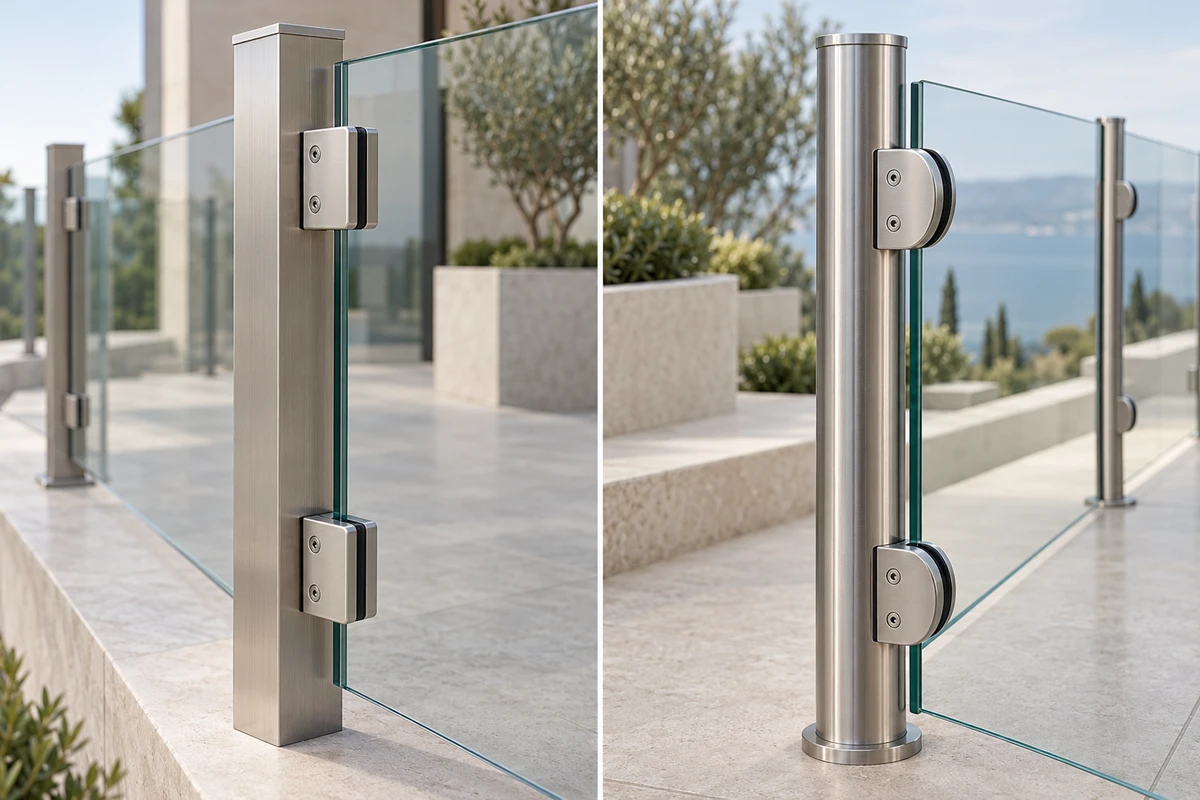
The back is the side that meets the post. A flat back fits a wall, floor or flat post. By contrast, a tube back is curved to sit tight on a round post.
A chart is a summary, so always check the drawing too. Each of our clamp pages shows a technical drawing with the body size, the glass slot and the fixing hole. In practice, the drawing answers questions a glass clamp size chart cannot, such as the screw size or the distance from the glass edge to the post. If a project engineer needs more data, we send the drawing with the quote.
Article numbers also follow a pattern. On our clamps, the model number appears in the article number, and the glass thickness and grade are added to it. As a result, the order clearly states which insert and which steel come with each clamp.
Glass thickness: single and laminated
Glass clamp sizes are always given for two glass types. Single glass is one tempered sheet, such as 8, 10 or 12 mm. Laminated glass is two sheets bonded with an interlayer, so it has an odd-looking thickness.
For example, 10.76 mm laminated glass is two 5 mm sheets with a 0.76 mm interlayer. Similarly, 12.76 mm is two 6 mm sheets, and 17.52 mm is two 8 mm sheets with a 1.52 mm interlayer. So when a glass clamp size chart says “6.76–12.76 mm laminated”, it means the clamp holds these bonded build-ups.
This matters for code reasons. IBC Section 2407 on glass in handrails and guards requires laminated glass in most guards, with a minimum nominal thickness of 1/4 inch (6.4 mm). As a result, laminated sizes are the common choice for balconies and stairs.
Glass clamp size chart: square clamps
Square clamps are the most popular shape, because they suit modern posts and look neat on stairs. The table below shows our square range.
| Model | Size | Glass (single / laminated) | Notes |
|---|---|---|---|
| MOD 2020 | 45 × 45 mm | 6–10 / 6.76–10.76 mm | Indoor, insert without pin hole |
| MOD 2025 | 45 × 45 mm | 6–10 / 6.76–10.76 mm | Standard 45 mm square |
| MOD 2021 | 45 × 45 mm | 6–10 / 6.76–10.76 mm | With baffle plate |
| MOD 2022 | 55 × 55 mm | 6–12 / 6.76–12.76 mm | Standard 55 mm square |
| MOD 2023 | 55 × 55 mm | 6–12 / 6.76–12.76 mm | With baffle plate |
| MOD 2024 | 70 × 55 mm | 10–12 / 10.76–17.52 mm | Heavy duty, panels 500–1,600 mm |
For most balconies with 12.76 mm laminated glass, the 55 × 55 mm size is the starting point. Our square glass clamp 55 × 55 mm shows the full specification and article numbers.
For heavy laminated glass, move up to the 70 × 55 mm body. Its rubber covers up to 17.52 mm, and its data lists panel widths from 500 to 1,600 mm.
Glass clamp size chart: D-shape and rectangular clamps
D-shape clamps have a rounded face and a flat side. They look softer than square clamps and suit round posts and classic designs.
| Model | Size | Glass (single / laminated) | Notes |
|---|---|---|---|
| MOD 2010 | 50 × 40 mm | 6–10 / 6.76–10.76 mm | Compact D-shape |
| MOD 2011 | 63 × 45 mm | 6–12 / 6.76–12.76 mm | D-shape for 12 mm glass |
| MOD 2012 | 63 × 45 mm | 6–10 / 6.76–10.76 mm | D-shape for 10 mm glass |
| MOD 2026 | 57 × 45 mm | 8–12 / 8.76–12.76 mm | Rectangular, panels up to 1,800 mm |
| MOD 2052 | 50 × 40 mm | On request | Single-sided, countersunk fixing |
Two models share the 63 × 45 mm body, so read the glass range carefully. For example, our D-shape glass clamp 63 × 45 mm for 12 mm glass is MOD 2011, while MOD 2012 is the version for 10 mm glass.
The rectangular 57 × 45 mm clamp is useful for wide panels. Because its data allows panels up to 1,800 mm, it can reduce the number of posts on a long run.
Glass clamp size chart: round and glass-to-glass clamps
Round clamps suit round posts and a softer look. Glass-to-glass clamps join panels without a post at all.
| Model | Type | Size | Glass |
|---|---|---|---|
| MOD 2030 | Round, single-sided | Ø60 mm | 6–12 / 6.76–12.76 mm |
| MOD 2031 | Round, double-sided | Ø60 mm | 6–12 / 6.76–12.76 mm |
| MOD 2032 | Round, hex screws | Ø60 mm | 6–12 / 6.76–12.76 mm |
| MOD 2050 | 180° glass-to-glass | 106 × 45 mm | 6–12 / 6.76–12.76 mm |
| MOD 2051 | 90° glass-to-glass | Corner | 6–12 / 6.76–12.76 mm |
| MOD 2054 | 180° glass-to-glass | In line | 10 or 12 mm |
| MOD 2055 | 90° glass-to-glass | 2 × 70 mm legs | 10 or 12 mm |
| MOD 2056 | 90° wall-to-glass | One screw | 10 or 12 mm |
| MOD 2057 | Adjustable 90°–225° | 2 × 94 mm legs | 10 or 12 mm |
Our round glass clamp Ø60 mm, double-sided is one of the most searched models. It holds glass on both sides of a post, so one clamp serves two panels.
Flat back or tube back?
The back must match the post, otherwise the clamp rocks and the glass loosens. Most of our clamps come with a flat back or a curved back for round tube from Ø33.7 to 50.8 mm.
Common post sizes are Ø42.4 mm and Ø48.3 mm. So when you order, state the exact tube diameter, not just “round”. A clamp curved for Ø50.8 mm will not sit tight on a Ø42.4 mm post.
Square posts use the flat back. In addition, wall and floor fixings use the flat back with a suitable anchor.
Finishes and grades
Clamp size is only half the order. The grade and finish decide how the clamp ages.
Most of our clamps come in AISI 304 or 316 stainless steel. Grade 304 suits dry indoor areas, while 316 suits pools, coastal sites and heavy pollution. For more detail, see our guide to 304 vs 316 stainless steel.
Finishes include brushed, polished, black, white and raw. Brushed hides fingerprints, while polished looks brighter. Black and white suit dark or light frames, and raw suits projects that are coated after delivery.
How to choose from the glass clamp size chart
Use the glass clamp size chart in this order, and the choice becomes simple. First, fix the glass type and exact thickness. Second, pick the shape that suits the post and the design. Third, choose the body size that holds that glass and suits the panel width. Fourth, pick the back, grade and finish.
Then check the count. Most infill panels use four clamps, two on each side, and wider panels use more. For the basics of how clamps grip the glass, see our guide to what glass clamp systems are and how they work.
Finally, order spare rubber inserts. Each glass thickness needs its own insert, and spares save a site visit.
Security pins, baffle plates and rubber inserts
Two clamps can share a body size yet hold the glass in different ways. That detail rarely shows in a glass clamp size chart, so it is worth a closer look.
Some clamps use a security pin. The pin passes through a small hole drilled in the glass, so the panel cannot slide out even if the rubber loosens. Other clamps use a baffle plate, which is a small stop inside the clamp that blocks the glass edge. Our MOD 2021 and MOD 2023 square clamps use the baffle plate method, so the glass needs no drilled hole.
Indoor clamps sometimes skip both. For example, MOD 2020 uses an insert without a pin hole, which suits indoor stairs where drilling the glass is not wanted.
The rubber insert sets the final fit. Each insert is cut for one glass thickness, and it protects the glass from the steel. So a single clamp body appears several times in a full glass clamp size chart, once for each insert.
Worked example: picking from the glass clamp size chart
Here is a typical indoor stair, so you can see the steps in order. The stair has round posts of Ø42.4 mm, and the client wants a slim look. The glass is 10.76 mm laminated, and the panels are about 900 mm wide.
First, we look for clamps that hold 10.76 mm laminated glass. The 45 × 45 mm square clamps and the 50 × 40 mm D-shape clamp all qualify. Next, the client prefers square edges, so we narrow it to the 45 × 45 mm square range.
Then we choose the holding method. The client does not want drilled glass, so MOD 2021 with a baffle plate is the best fit. Finally, we choose a tube back for Ø42.4 mm, grade 304 for a dry indoor stair, and a brushed finish.
The same steps work for any project. Glass first, then shape, then size, then back, grade and finish.
Code points for the USA and Canada
Clamp size alone does not make a guard compliant. The glass, the layout and the top rail all count. Under the IBC, guards must resist set loads, and glass guards use a factor of safety of four.
The IBC also names the safety glazing standards. Glass in guards must comply with Category II of 16 CFR Part 1201, the US safety standard for architectural glazing, or Class A of ANSI Z97.1. In Canada, the National Building Code and provincial codes apply, so check the local rules with the project engineer.
Cost: what changes the price
Clamp prices depend on body size, grade, finish and quantity. A 70 × 55 mm clamp in 316 costs more than a 45 × 45 mm clamp in 304. Black, white and polished finishes add steps, so they cost a little more than brushed.
For a fast quote, send the glass thickness, post size, panel sizes, grade and finish. With that, a supplier can choose from the glass clamp size chart and count the clamps in one step.
Why buy from a clamp manufacturer
A manufacturer controls the clamp body, the rubber and the finish, so the parts match. UNIKIM has over 20 years of manufacturing experience in Ningbo, and we make clamps in 304 and 316 stainless steel. We supply OEM and wholesale orders, with mixed containers of clamps, posts and handrails.
You can also browse our range on our store on Made-in-China.
Every clamp in this guide is listed with drawings and article numbers in our glass clamps category.
FAQ
For 12 mm single glass or 12.76 mm laminated glass, choose a clamp with a 6–12 mm range, such as a 55 × 55 mm square clamp or a 63 × 45 mm D-shape clamp. The glass clamp size chart above lists each model’s range. Always order the rubber insert for the exact thickness, because a 10.76 mm insert will not hold 12.76 mm glass.
For balconies with laminated glass, 55 × 55 mm square clamps are very common. For indoor stairs with thinner glass, 45 × 45 mm square clamps and 50 × 40 mm D-shape clamps are popular. A glass clamp size chart helps you match each size to the glass thickness and the post before you order.
Yes, but only heavy-duty models. In our glass clamp size chart, the 70 × 55 mm square clamp MOD 2024 holds 10–12 mm single glass and 10.76–17.52 mm laminated glass. Smaller clamps stop at 10.76 or 12.76 mm. Heavy laminated glass is common on commercial balconies and stairs.
A tube back is curved to fit a round post, so the clamp sits tight without gaps. Our clamps come with flat backs or tube backs for posts from Ø33.7 to 50.8 mm. Use the glass clamp size chart to pick the body, then state the exact post diameter when you order.
The sizes are the same, but the grade often changes. Grade 304 stainless steel suits dry indoor areas. For pools, coastal sites and polluted areas, 316 resists chloride staining much better. So pick the size from the glass clamp size chart first, then choose 304 or 316 for the site.
Summary
A glass clamp size chart turns a long catalogue into one decision: match the clamp body and rubber to the glass, then match the back to the post. Square, D-shape, round and glass-to-glass clamps each cover set glass ranges, from 6 mm single glass up to 17.52 mm laminated glass. After the size, choose 304 or 316 and the finish, and check the layout with your engineer.
UNIKIM makes every clamp in this chart in its own factory, with matching rubber inserts and finishes. Send us your glass and post sizes, and we will confirm the model and return a quote. Contact UNIKIM for a quotation.