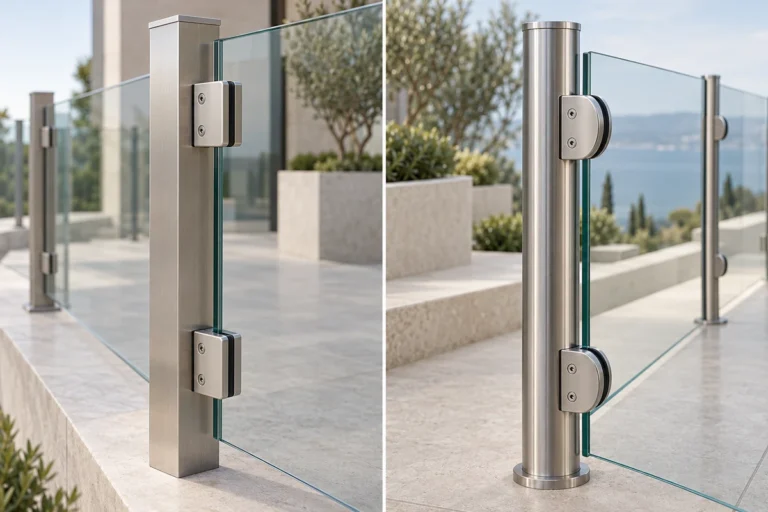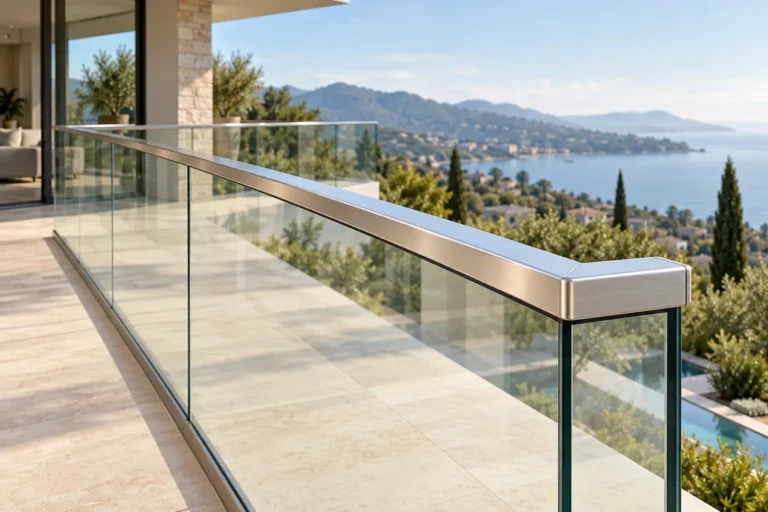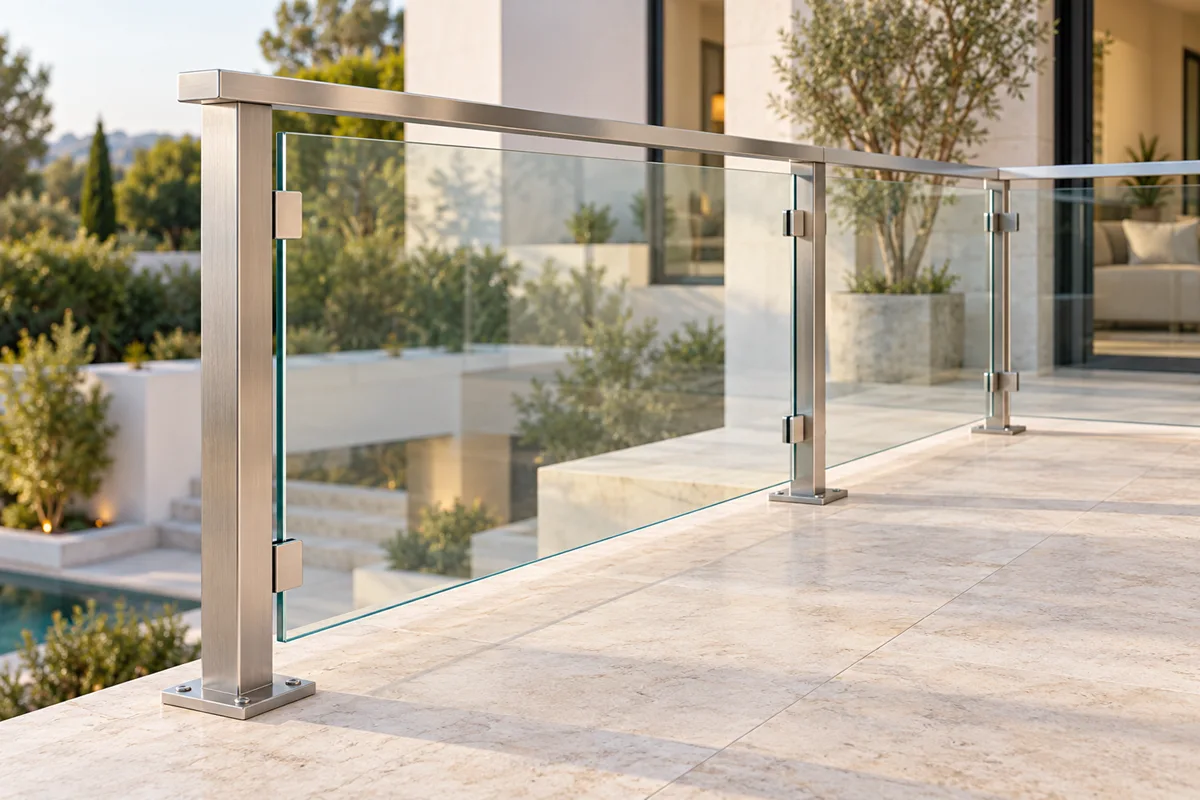
Missing glass railing parts stop more jobs than broken glass does. A single forgotten end cap or rubber strip can hold up a handover for a week. This guide lists every part for the four main frameless systems and gives you a bill of materials (BOM) template to copy. At UNIKIM we make these parts in our Ningbo factory, so the list follows how we pack real orders.
Why a parts list matters on glass railing jobs
A glass railing looks simple, yet it has many small glass railing parts. Each system uses its own fixings, rubbers and covers. So one wrong item can delay glazing, because the glass cannot go in without its gaskets.
A clear BOM also protects the budget. It shows every part before the order, so nothing is added at air-freight prices later. In practice, distributors use the same list to stock the parts that sell together.
The four main frameless systems
Most frameless railings use one of four ways to hold the glass. The parts list changes with each one, so pick the system first.
| System | How the glass is held | Typical sites |
|---|---|---|
| Spigots | Short posts clamp the glass from below | Pool fences, decks, balconies |
| Standoffs | Round pins bolt through holes in the glass to the slab edge | Stairs, mezzanines, side-mounted balconies |
| Clamps and posts | Clamps fix the glass to posts | Stairs, balconies, renovation work |
| Base shoe | An aluminum channel holds the glass along its full length | Balconies, commercial guards |
Our guide to glass railing mounting hardware compares the four systems in more depth. Below, we focus on the glass railing parts each one needs.
Glass railing parts for a spigot system
A spigot system has few parts, but each one must match the glass. The main parts are the spigots, the rubber gaskets for the glass thickness, the anchors and, where needed, a top rail.
Spigots come in round and square shapes, for core-drilled or surface mounting, and in side-mount versions for fascias. For example, our square spigots use a 48 mm post with a 104 × 104 mm base, while side-mount spigots fix to the slab edge. You can compare them in our glass spigot category.
Do not forget the small items. Each spigot needs gaskets for the exact glass thickness, a cover plate if the base must be hidden, and anchors that suit the substrate.
Glass railing parts for a standoff system
Standoffs bolt through holes in the glass and hold it off the wall or slab edge. So the glass railing parts list must include the standoffs, their washers and gaskets, and the right anchors.
The glass must be drilled at the factory to match the standoff hole size. Because the holes cannot be added after tempering, the standoff model must be fixed before the glass order. Our glass railing standoff hardware MOD 2700 uses an M10 × 300 mm threaded rod, which suits deep chemical anchors in concrete.
Count four standoffs per panel as a starting point, then follow the engineer’s layout. Stair panels often need a different hole pattern on each panel.
Glass railing parts for a clamp and post system
Clamp systems have the longest parts list, because posts, clamps and handrails all meet. Here, a missing connector or end cap is easy to miss.
The core parts are posts, base plates and covers, glass clamps with rubber inserts, a handrail with brackets or a post-top connector, tube connectors for corners, and end caps. In addition, stairs need angled connectors and wall brackets at the ends.
Our clamp range covers glass from 6 to 17.52 mm, with flat or tube backs for posts from Ø33.7 to 50.8 mm. As a result, one clamp model rarely fits every panel on a mixed job, so list the glass thickness per panel.
Glass railing parts for a base shoe system
A base shoe holds the glass along its full length, so it suits heavy laminated glass. The parts list includes the aluminum profile, the glazing kit, corners, end caps and the fixings.
For example, our top-mount aluminum base shoe MOD 0600 is 121 × 45 mm, in 2,500 or 5,000 mm lengths. Its fixing holes are Ø14 mm, every 171.43 mm. The matching glazing kit holds glass from 12 to 21.52 mm.
The glazing kit is the item most often forgotten. Our glazing kit MOD 0800 (2.5 m) and MOD 0900 (5 m) includes setting blocks, clamping wedges and two gasket strips per length. Without it, the glass cannot be fixed in the channel.
Corners and ends need their own parts too. A base shoe run with one outside corner needs an external corner piece, while an inside corner needs an internal piece. In addition, every open end needs an end cap, so count the ends on the drawing as carefully as the length.
Top rails and handrails
Many glass railings need a top rail or handrail on top of the glass. So add these glass railing parts to every system above, unless the engineer confirms otherwise.
The code links glass guards and top rails. IBC Section 2407 on glass in handrails and guards requires an attached top rail on guards with structural glass balusters, unless the glass is laminated with two or more equal plies and tested to ASTM E2353.
Count the rail fittings from the drawing, not from the run length alone. Every open end needs an end cap, every wall end needs a wall flange, and every corner needs a corner fitting. On stairs, each change of pitch needs an adjustable joint. As a result, a short stair can need more fittings than a long straight balcony.
A slot tube rail is the most common top rail on frameless glass. Our slot tube handrail system lists the tube, nine fittings and the rubber strips in one place.
Free BOM template for glass railing parts
Copy this template into a spreadsheet and fill one row per item. It works for quotes, site orders and stock planning.
| Item | Model / size | Quantity rule | Notes |
|---|---|---|---|
| Glass panels | Type, thickness, size | 1 per panel | Laminated or tempered; holes for standoffs |
| Spigots or standoffs or clamps | Model and glass range | Per panel, by layout | Match the rubber to the glass |
| Posts | Diameter, height, wall | 1 per post position | Include stair rake |
| Base plates and covers | Size | 1 per post | Cover hides the anchors |
| Base shoe profile | Length | Run length + cutting | Corners extra |
| Glazing kit | Length | 1 per profile length | Check the glass thickness |
| Rubber inserts / gaskets | Glass thickness | 1 set per fixing + 10% | Spares save site visits |
| Top rail or handrail | Profile and size | Run length + joints | Graspable size on stairs |
| Rail fittings | End caps, corners, flanges, joints | Count per layout | One per end, corner and wall |
| Anchors and screws | Size, substrate | Per fixing | Concrete, steel or timber |
| Finish and grade | 304 or 316; brushed, polished, black | Whole job | One grade per site |
Fill the quantity column from the drawing, not from memory. Then add 5–10% spare on small items such as rubbers and screws. Finally, send the filled template with the drawing, because the two together answer almost every question a supplier will ask.
Worked example: glass railing parts for a 10 m balcony
Here is a simple clamp-and-post balcony, so you can see the template in use. The balcony is a straight 10 m run between two walls. The posts are Ø42.4 mm, and the glass is 12.76 mm laminated. A stainless handrail runs on top, and the site is inland.
First, the layout gives nine panels of about 1,050 mm and ten posts. Next, each panel takes four square clamps of 55 × 55 mm with tube backs, so the job needs 36 clamps and 36 sets of 12.76 mm rubber inserts, plus about 10% spare inserts.
Then come the posts and fixings. Ten posts need ten base plates, ten covers and the anchors for concrete. On top, the handrail needs 10 m of tube, two wall brackets at the ends and connectors at each post top.
Finally, we choose 304 stainless steel because the site is dry and inland, with a brushed finish. That short list covers every one of the glass railing parts, so the factory can quote in one pass.
How distributors use a glass railing parts list
Distributors use the same list in a different way. Instead of one job, they plan stock for many small jobs.
In practice, the best-selling glass railing parts are the ones installers forget. Rubber inserts for common glass sizes, end caps, wall flanges and anchors run out first. So a distributor’s stock list often weights these small items more than the main fittings.
A clear parts list also helps with mixed containers. For example, clamps, posts, slot tube and spigots can ship together, which lowers freight per part. Our page on becoming a railing hardware distributor explains how we supply stock orders.
Checking heights and openings before you order
Codes affect the parts list, because they set heights and gaps. Under IBC Section 1015 on guards, required guards are at least 42 inches (1,067 mm) high. Openings must not pass a 4-inch (102 mm) sphere.
In homes covered by the IRC, the guard height is 36 inches. Therefore check which code applies, because the post height and glass height follow it. In Canada, the National Building Code and the provincial codes apply.
These rules change the glass railing parts list directly. A taller guard needs taller glass, longer posts and sometimes stronger fixings.
Materials and grades for glass railing parts
Most glass railing parts are stainless steel, while base shoes are aluminum. Grade 304 suits dry indoor areas. By contrast, 316 resists chlorides near pools and the sea, so it is the safer outdoor choice.
Glass choice also changes the list. Laminated glass has an interlayer, so its thickness differs from single glass, for example 12.76 mm instead of 12 mm. As a result, the rubbers and gaskets must be ordered for the laminated size.
Cost: what changes the price of a parts list
The system type sets the base cost. A base shoe needs more aluminum per metre, while spigots and standoffs cost more per fixing point. In addition, grade 316 and black or polished finishes raise the price.
Smart lists save money. For example, using one clamp model across the job lowers the unit price and the spares count. Similarly, mixing posts, clamps and rails in one container lowers freight per part.
Why order glass railing parts from one manufacturer
Buying every part from one factory keeps the sizes matched. UNIKIM has over 20 years of manufacturing experience in Ningbo, China. We make spigots, standoffs, clamps, posts, slot tube and fittings in 304 and 316 stainless steel, with OEM and wholesale supply.
One supplier also means one quote and one container. You can see the full range in our frameless glass railing systems category.
For buyers who prefer a trade platform, the same products are listed on our store on Made-in-China.
FAQ
The main glass railing parts are the glass, the fixings that hold it (spigots, standoffs, clamps or a base shoe), rubber gaskets for the glass thickness, anchors, and usually a top rail with its fittings. Clamp systems also need posts, base plates and end caps. Use a BOM template so no small part is missed.
Common names are spigots, standoffs, glass clamps, base shoe or channel, glazing kit, gaskets or rubber inserts, top rail or cap rail, end caps, wall flanges and connectors. Different markets use different words, so a parts list with sizes and drawings avoids confusion when ordering glass railing parts from abroad.
Start from the drawing. Count panels, then fixings per panel, posts, corners, wall ends and open ends. Add the top rail length and its fittings, then rubbers and anchors with 5–10% spare. The BOM template above turns these steps into rows, so the glass railing parts list matches the layout.
No. Most glass railing parts are made for a set glass thickness, post size or profile. A clamp for 10.76 mm glass will not hold 12.76 mm glass, and slot tube fittings must match the tube diameter. Therefore buy matched parts from one system, or check every size against the drawing.
Use 304 for dry indoor areas and 316 for pools, coastal sites and polluted areas. Mixing grades on one site can cause the 304 parts to stain first. So choose one grade for all glass railing parts on a project, and match the screws and anchors to it.
Summary
A complete list of glass railing parts starts with the system: spigots, standoffs, clamps and posts, or a base shoe. Then add the rubbers, anchors, top rail and fittings, and check heights and openings against the code. The BOM template above turns that into a clear order, with spares for the small items.
UNIKIM makes the parts for all four systems in 304 and 316 stainless steel, and packs them as one order. Send us your drawing or filled BOM, and we will check it and return a quote. Contact UNIKIM for a quotation.