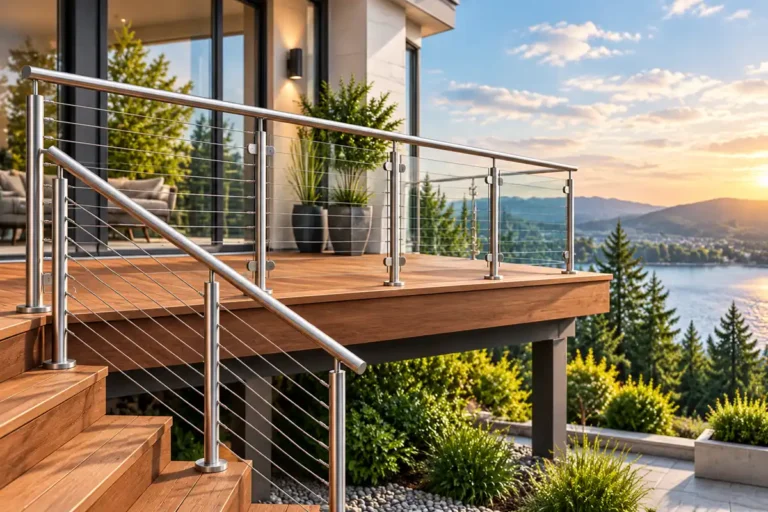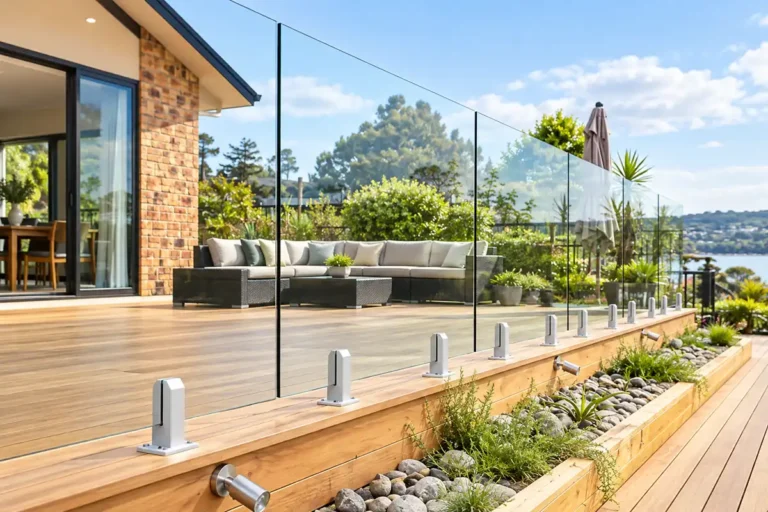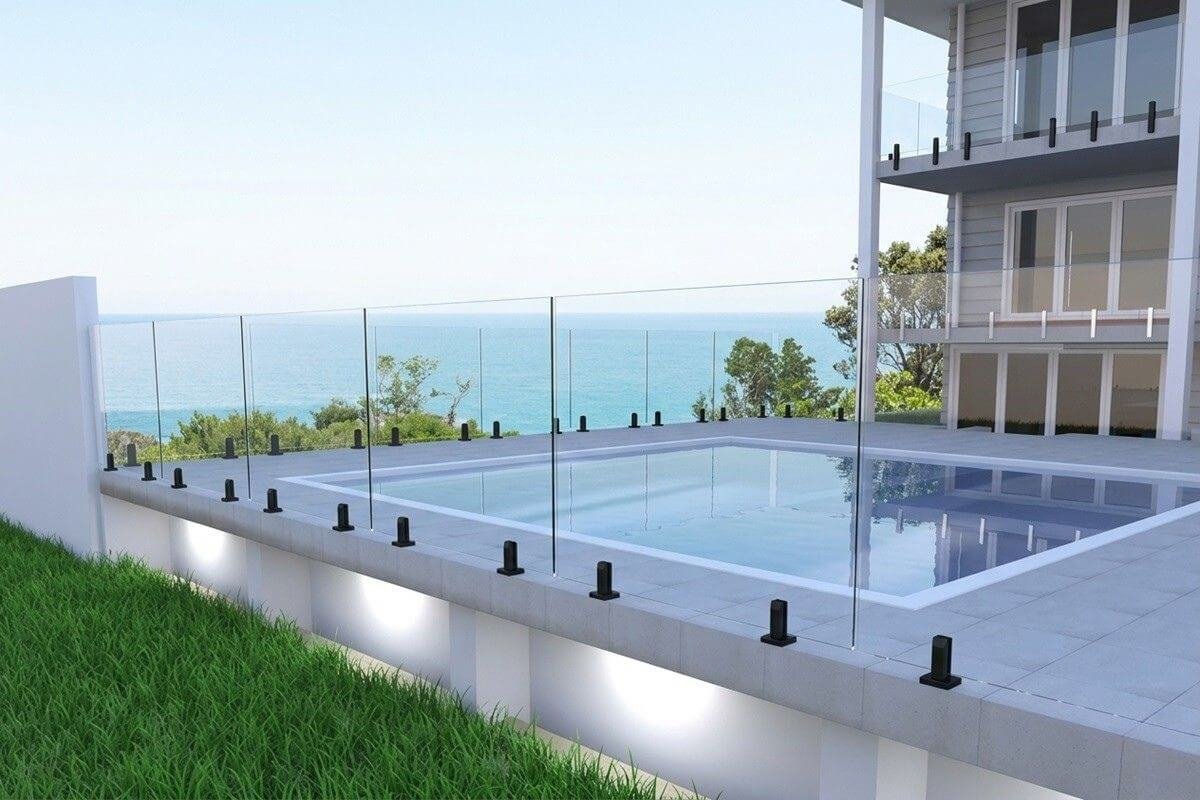
A frameless glass pool fence may look simple, but the hardware at the bottom of each panel is doing serious work. Glass pool fence spigots support the glass, transfer loads into the mounting surface, help maintain panel alignment, and make the clean “floating glass” appearance possible.
Choosing the right spigot is not simply a matter of picking a square or round shape. Mounting method, stainless steel grade, glass thickness, substrate, environmental exposure, anchor design, local pool-barrier rules and the tested configuration of the complete system all matter.
That becomes especially important around swimming pools, where hardware is exposed to moisture, cleaning chemicals, airborne salts and, in coastal locations, marine chloride. Type 316 stainless steel offers greater chloride resistance than 304 because of its molybdenum content, while Duplex 2205 can provide still greater strength and resistance in demanding chloride environments. [7]
This guide explains how to compare surface-mounted, core-drilled and side-mounted spigots; how to choose between 304, 316 and Duplex 2205 stainless steel; what to check for glass and substrate compatibility; how to approach installation and maintenance; and what technical documentation to request from a supplier.
One rule comes before everything else: a spigot is only one component of a pool-barrier system. The glass, spigots, anchors, substrate, gates, hinges, latches, panel dimensions and installation must work together and satisfy the rules that apply where the fence is installed.
What Are Glass Pool Fence Spigots?
Glass pool fence spigots are compact mounting fittings that hold the lower portion of frameless glass panels without conventional full-height posts.
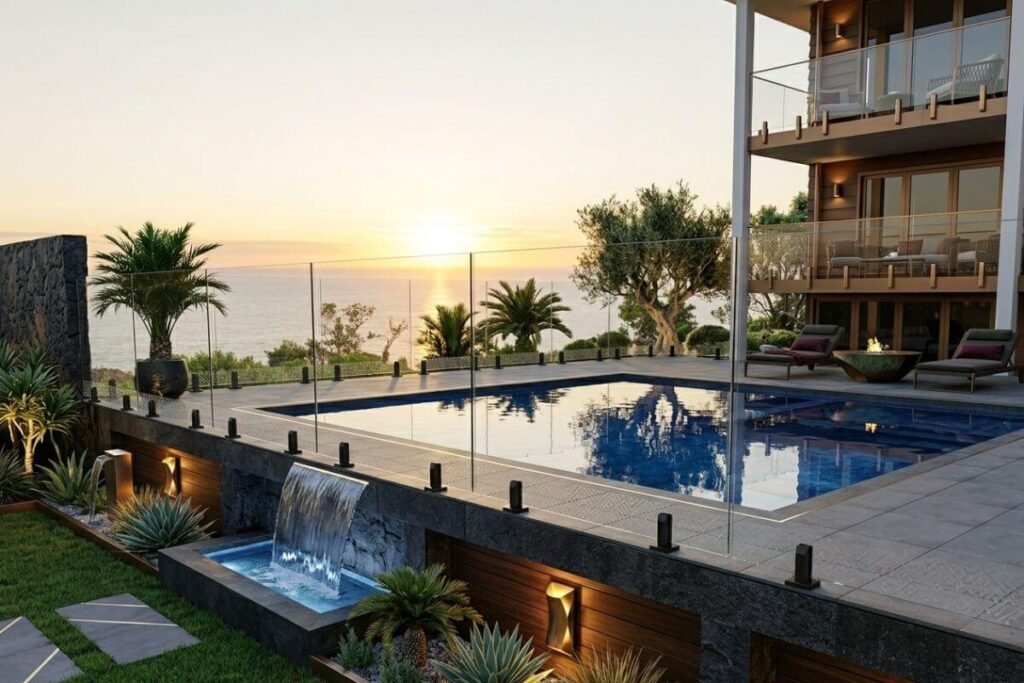
A typical friction-clamp design places protective inserts or gaskets between the stainless steel body and the glass. The spigot is then connected to the supporting structure by a surface-mounted base plate, an embedded/core-drilled body or a side-mounted fixing system.
This creates a largely uninterrupted glass barrier while keeping most of the structural hardware close to the deck.
UNIKIM currently offers stainless steel pool fence spigots in AISI 304, AISI 316 and Duplex 2205 options, while its side-mount glass spigot is offered for side-fixed architectural applications. Exact glass compatibility varies by model, which is why the product drawing and specification should always be checked before ordering.
How a spigot holds the glass
A quality spigot does more than stop a panel from falling over.
The installed system needs to control movement, keep the panel correctly aligned and transfer forces from the glass into the supporting structure. The glass-to-spigot interface, the spigot body, fixing bolts or grout, and the substrate therefore operate as one structural path.
That is why buying a “heavy-duty spigot” without checking the mounting surface is not enough. A strong fitting connected to an unsuitable slab, weak deck structure or incorrect anchor can still produce a poor installation.
The same applies to the glass. The fact that a clamp physically opens wide enough to accept a panel does not prove that the glass-and-spigot combination is suitable for the intended barrier.
Why pool applications deserve extra attention
Pool environments combine structural and corrosion concerns.
Chlorides are particularly relevant to stainless steel selection. Nickel Institute notes that the molybdenum addition in Type 316 improves its resistance to chlorides compared with Type 304. For more aggressive chloride environments, Duplex 2205 can be considered because of its improved corrosion and stress-corrosion resistance.
This does not mean that every pool automatically needs the most expensive alloy available. It means the material should be selected for the actual exposure rather than by price alone.
Types of Glass Pool Fence Spigots
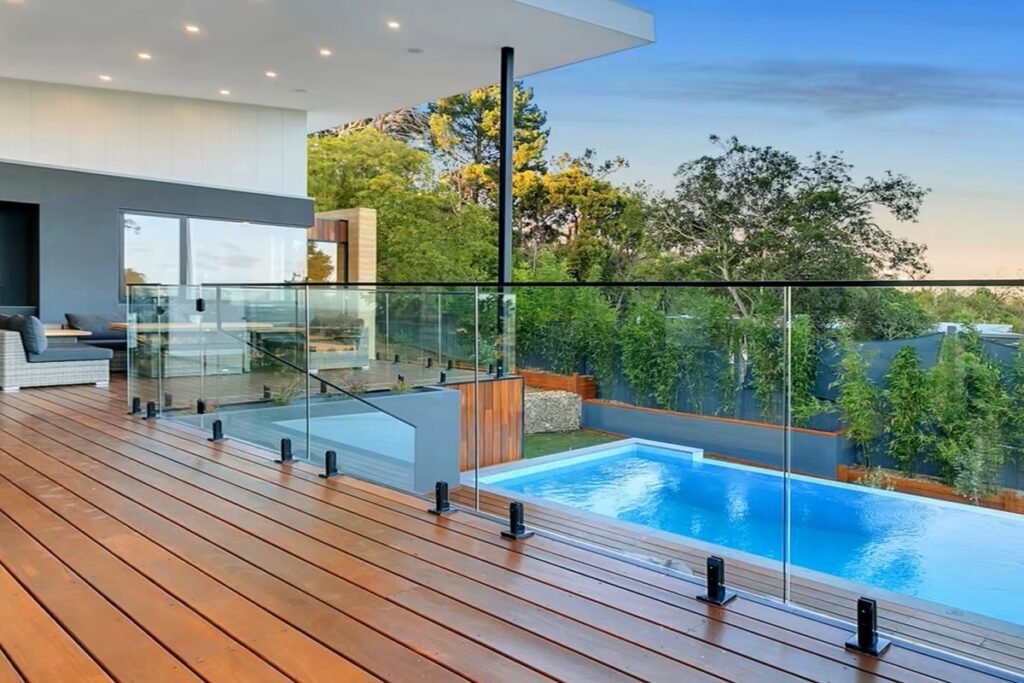
The three mounting families most buyers encounter are surface mounted, core drilled and side mounted.
Each can produce a clean frameless result. The right choice depends on the structure beneath the finished surface, the desired appearance, access for drilling and fastening, drainage, edge distances and the requirements of the tested system.
| Spigot type | How it mounts | Best suited to | Main advantages | Main points to check |
| Surface/base-plate spigot | Base plate is mechanically or chemically fixed to the top of the supporting surface | Existing concrete slabs, suitable decks and retrofit projects | Accessible fixing, straightforward servicing, no deep embedded body | Substrate strength, anchor specification, waterproofing, edge distance and base-plate level |
| Core-drilled spigot | Extended body is inserted into a prepared hole and secured using the specified fixing/grouting system | Solid concrete and projects prioritizing minimal visible hardware | Very clean appearance and reduced visible base hardware | Hole geometry, concrete condition, embedment, drainage, grout/fixing system and alignment |
| Side/face-mount spigot | Fitting attaches to the vertical face of the supporting structure | Narrow decks, slab edges and projects requiring clear usable surface space | Keeps hardware away from the deck surface and can create a floating visual effect | Edge structure, fixing access, concrete/deck capacity, waterproofing and tested glass configuration |
Surface-mounted or base-plate spigots
A surface-mount spigot sits on top of the slab, deck or other engineered support and is secured through a base plate.
This configuration is attractive for retrofit work because the fixing points remain accessible. It can also simplify future inspection and replacement compared with an embedded fitting.
Do not interpret “easy to install” as “suitable for every surface.” Tile, stone or composite decking may only be the finish layer. The structural connection usually needs to transfer load into an adequate supporting member beneath that finish.
Current commercial products commonly pair base-plate designs with frameless pool fencing, and some competing systems are sold specifically for 10–12 mm glass. [24] The exact panel size, glass thickness, anchors and substrate still need to match the selected system.
Core-drilled spigots
Core-drilled spigots have an extended lower body installed into a prepared opening in a suitable structural substrate.
They are popular when the design goal is minimal visible hardware because a large mounting plate does not need to remain above the finished surface.
The trade-off is that installation accuracy and substrate preparation become especially important. Hole location, depth, alignment, fixing or grout selection, curing and water management should follow the manufacturer’s tested installation method rather than a generic internet dimension.
A core-drilled detail that works for one product should not automatically be copied for another.
Side-mount or face-mount spigots
Side mounting moves the primary fixing onto the vertical face of a slab or deck structure.
That can preserve more usable deck space and produce an especially clean sight line from above. It can also be useful where top fixing would interfere with the finished walking surface.
UNIKIM’s current side-mount model is specified in stainless steel grades including 304, 316 and 2205 and is offered for frameless pool and architectural glass applications.
Side mounting should still be treated as an engineered connection. Fixing near an edge introduces different structural considerations from fixing into the middle of a broad slab, so the supporting structure and anchors need to be assessed accordingly.
Round vs square spigots
Round and square bodies are largely an architectural choice when comparing products of equivalent tested performance.
Square fittings often match contemporary rectangular railing details. Round fittings can coordinate naturally with round handrails, hinges and other curved hardware.
Do not choose between them based on shape alone. Material grade, dimensions, glass interface, mounting configuration, test data and project compatibility matter more than whether the visible body is round or square.
Choosing the Right Stainless Steel Grade
The material designation stamped on a quotation is not decorative fine print. It directly affects corrosion resistance, price and suitability for the installation environment.
For many buyers, the first comparison is 304 vs 316 stainless steel.
| Factor | 304 stainless steel | 316 stainless steel |
| General corrosion resistance | Good in suitable mild environments | Higher resistance in more aggressive environments |
| Molybdenum | Generally no intentional Mo addition comparable with 316 | Contains molybdenum, improving chloride resistance |
| Poolside use | Requires careful environmental assessment | Commonly preferred for poolside/outdoor applications |
| Coastal/chloride exposure | Less suitable as chloride severity increases | Better than 304, although severe marine exposure may justify higher-alloy or Duplex grades |
| Relative cost | Usually lower | Usually higher |
| Maintenance | Still requires cleaning and inspection | Still requires cleaning and inspection |
| Selection principle | Choose only when exposure and project requirements justify it | Stronger default candidate for demanding outdoor/pool conditions, subject to project assessment |
Nickel Institute identifies the molybdenum in 316 as the reason for improved resistance to chlorides compared with 304. Out like wise places 304 in lighter atmospheric exposure and recommends 316 or stronger grades as corrosion severity increases.
304 stainless steel
304 is a widely used austenitic stainless steel with good general corrosion resistance.
It can be a sensible choice where environmental exposure is mild and the complete project specification permits it. Its lower alloy content also commonly makes it more economical than 316.
The mistake is not using 304 anywhere. The mistake is specifying it automatically for every outdoor pool because it costs less.
If the project is near the sea, exposed to chloride deposits, poorly rinsed or subject to an aggressive maintenance environment, a more resistant grade may be a better lifecycle choice.
316 stainless steel
316 is commonly marketed as a marine-grade stainless steel and is widely used for outdoor architectural hardware.
Its molybdenum content improves resistance to pitting in chloride-containing environments compared with 304.
For many poolside projects, that makes 316 a stronger starting point.
It is not invincible.
Surface finish, fabrication quality, contamination, water retention, cleaning frequency, chloride concentration and local environment all affect service performance. Even corrosion-resistant stainless steel benefits from appropriate maintenance.
For a deeper material discussion, see UNIKIM’s guide to 316 stainless steel glass spigots.
Where Duplex 2205 fits
A modern comparison should not stop at 304 versus 316 because Duplex 2205 appears throughout today’s pool-fence spigot market.
Duplex stainless steels combine high mechanical strength with good corrosion resistance, and 2205 offers strong resistance to uniform/localized corrosion and stress-corrosion cracking. Outokumpu recommends 2205 among the options for coastal or industrial-marine atmospheric conditions.
That explains why several current pool-spigot competitors feature 2205 as a premium material.
UNIKIM likewise lists Duplex 2205 among the available grades for several spigot models.
The practical buying lesson is simple:
Do not ask only, “Is it stainless steel?”
Ask:
What exact grade is supplied, how is that grade verified, what finish is used, and is that material appropriate for my site’s exposure?
Surface finish matters too
Two components made from the same nominal grade can perform differently if fabrication and surface condition differ.
Notes that smoother, cleaner surfaces generally provide better atmospheric corrosion performance, while rough surfaces can trap contaminants and moisture. Post-fabrication cleaning and surface treatment can also be important where processing has contaminated or damaged the stainless surface.
For a supplier, this means “316 stainless steel” should not be the end of the conversation. Buyers should also ask about finishing, polishing, passivation or other relevant processing and quality controls.
Glass Compatibility, Spacing and System Design
One of the easiest mistakes to make online is to turn a product-specific specification into a universal rule.
Glass pool fences are systems. Glass thickness, panel width and height, spigot geometry, number of supports, wind or barrier loads, edge distances, gates and substrate design can all affect the final configuration.
What glass thickness works with pool fence spigots?
There is no single thickness that every spigot accepts.
For example, one current UNIKIM pool spigot page lists 10 mm and 12 mm glass with customization available, while the side-mount product lists a 10–13 mm range in its summary and 10–12 mm in a specification section.
Competitor products also vary: some are explicitly designed for 10–12 mm glass while others are offered for 12 mm or 15 mm panels.
Therefore the correct buying question is not:
“What thickness do pool fences always use?”
It is:
“What glass type, thickness, dimensions and support arrangement has this exact spigot system been designed or tested to accept?”
The supplier’s technical drawing and system documentation should answer that before fabrication begins.
How many spigots are needed per panel?
Two supports are common on many frameless panels, and UNIKIM itself describes two or three spigots per panel depending on required stability on one product page.
But “two per panel” should not be published as a universal structural rule.
Panel width and height, glass specification, wind exposure, mounting method, load requirement and manufacturer testing can alter the design.
For safety-critical work, use the tested layout, engineering documentation and applicable local requirements rather than a generic spacing formula copied from another manufacturer’s product.
Substrate and anchors
The spigot is only as reliable as the structure to which it is connected.
Before selecting anchors, identify the actual structural material beneath the visible finish. Concrete, timber framing, structural steel and other substrates require different connections.
A tiled pool deck illustrates the point perfectly: fixing into the tile is not the same thing as establishing a structural connection to the slab beneath it.
The specification should therefore identify:
the substrate;
spigot type;
anchor or fixing method;
edge clearances;
waterproofing/drainage considerations;
glass specification;
and the manufacturer’s required installation arrangement.
This is also the right stage to determine whether local electrical/bonding rules affect metallic hardware around the pool. Those requirements vary by jurisdiction, so electrical safety should be checked against the applicable local code and a qualified professional rather than handled by a generic worldwide rule.
Finish and accessory selection
Satin, polished and coated finishes can change the visual character of a frameless system dramatically.
But appearance should be selected after the technical requirements are known.
For coated black or colored hardware, ask what coating system is used, how coating damage is handled during installation and whether the supplier has exposure data for the intended environment.
For stainless finishes, ask how the surface was finished and what cleaning method the supplier recommends.
Pool Fence Compliance and Documentation
“Compliant” is one of the most overused words in architectural hardware marketing.
A manufacturer may have a certified quality-management system. A stainless steel grade may conform to a material specification. A complete barrier may have been tested to a standard. A local building inspector may evaluate the installed fence against legislation.
Those are different things.
A serious supplier should be able to tell you exactly what document applies to exactly what product or system.
Australia
Standards Australia released AS 1926.1:2024, Swimming pool safety — Safety barriers for swimming pools, covering requirements intended to restrict young children’s access to pools.
Glass selection and installation are also addressed through AS 1288:2021, Glass in buildings — Selection and installation, which covers areas including glass strength, human impact, wind loads, fixing methods and barrier assemblies.
However, publication of a standard and legal adoption are not always the same event. Regulations can vary between states, territories and project types. Always establish the edition and regulatory framework actually applicable to the project before stating that a product is “Australian compliant.”
United States and ASTM references
ASTM F1908 is a guide for fences for residential outdoor swimming pools, hot tubs and spas.
Importantly, ASTM itself states that the guide does not have the force of law and does not supersede applicable codes.
Therefore a supplier should not simply write “ASTM certified” without identifying the exact standard, what was evaluated, who performed the evaluation and how that evidence applies to the installed system.
Local building, pool, glazing and electrical requirements may also apply.
Europe and CE marking
CE marking should also be described precisely.
The European Commission explains that not all products require CE marking. It applies where relevant EU legislation requires it, and CE marking does not mean that an EU authority has independently “approved” the product as safe.
Before advertising a glass spigot as “CE certified,” establish which legislation, harmonised standard or assessment route actually applies and retain the required conformity documentation.
Vague certification language creates more risk than value.
ISO 9001
ISO 9001 is highly relevant when evaluating a manufacturer’s quality-management processes.
It can support confidence that a supplier has a structured system for quality management and continual improvement. But ISO 9001 certification applies to the original station’s management system; it is not a substitute for product-specific structural or pool-barrier evidence.
A good buyer therefore distinguishes between:
factory-system evidence and product/system performance evidence.
Both matter, but they answer different questions.
What documents should a serious buyer request?
Before committing to a commercial order, request documentation relevant to the actual project.
That may include the material grade or material certificate, product drawing, glass compatibility, installation instructions, fixing information, surface-finish specification, available structural test reports, relevant compliance evidence, quality-system certificate and warranty terms.
For an OEM or large project, also establish revision control. The drawing approved for the order should be the same design the factory manufactures and inspects.
A certificate belonging to an unrelated model is not meaningful evidence for the product being purchased.
Installation and Maintenance
A high-quality spigot cannot compensate for a poor installation.
The safest approach is to treat installation as a controlled sequence rather than “drill holes, insert glass, tighten everything.”
Pre-installation planning
Start by confirming the local pool-barrier requirements and the approved system specification.
Then check the site:
Is the substrate structurally suitable?
Is the finished deck hiding a different support material below?
Where will gates, corners and returns be positioned?
Does drainage cause water to collect around the fitting?
Has the correct glass already been fabricated?
Are the spigot type, gasket/inserts, anchors and finish correct?
Are there local electrical requirements for conductive components in the pool zone?
Resolve those questions before drilling.
General installation workflow
The exact manufacturer’s method must always take priority, but the overall workflow normally follows a logical sequence:
Confirm code and system specification → inspect substrate → set out the fence line → mark mounting positions → prepare holes/fixings → install and align spigots → install protective inserts → place the specified glass → align panels → tighten/fix according to manufacturer instructions → install and test gate hardware → carry out final inspection.
Do not publish a universal bolt torque, hole depth, edge offset or spigot spacing unless it comes from the exact system’s validated documentation.
Those are engineering parameters, not generic SEO facts.
Common installation mistakes
Treating the finish surface as the structure. Tile or decking can hide an inadequate fixing base.
Mixing components from incompatible systems. A gasket or anchor that physically fits may not form part of the tested arrangement.
Using the wrong glass thickness. Clamp geometry and inserts should match the specified panel.
Poor alignment. Forcing misaligned glass into position can introduce stress and produces a visibly poor result.
Ignoring water management. Persistent contamination and trapped moisture make corrosion control harder.
Overtightening by feel. Glass hardware should be assembled to the product manufacturer’s method rather than “as tight as possible.”
Assuming every panel needs the same generic spacing. Follow the design for the specific system.
Preventing corrosion and staining
No stainless steel grade should be interpreted as “maintenance free.”
Environmental deposits should be removed before they remain on the surface for long periods. Coastal and high-chloride installations generally justify greater attention than sheltered inland locations.
Use cleaning products and methods recommended for the supplied finish, and avoid practices that contaminate stainless surfaces with ordinary carbon steel.
Notes that surface roughness, trapped contaminants and surface treatment influence atmospheric corrosion behavior.
For more maintenance detail, see UNIKIM’s guide to pool chemicals and glass spigot care.
Periodic inspections should also look beyond cosmetic staining. Check for loose hardware, movement, damaged coatings, deteriorated inserts, cracked glass, substrate deterioration and gate malfunction.
A pool barrier is a safety system, so a maintenance inspection should consider function as well as appearance.
How to Choose a Glass Pool Fence Spigot Supplier
A polished product photograph tells you almost nothing about manufacturing consistency.
A professional supplier should be able to move comfortably from marketing language to technical detail.
Start with the material.
Ask whether the quoted grade is 304, 316, 2205 or another alloy and how that grade can be verified.
Then review the drawing.
You should understand the overall dimensions, glass range, installation method, inserts, fasteners and available finishes before the order is placed.
Next, ask about testing and compliance.
The right question is not:
“Do you have certificates?”
It is:
“Which reports apply to this exact model and configuration, which standard was used, who issued the report, and can I review the document?”
Then examine manufacturing control.
For a repeat wholesale or project order, ask how material, dimensions, finish, assembly and packaging are inspected. If you are purchasing a custom/OEM design, establish how drawing revisions, samples and final inspection are controlled.
Finally
A supplier that asks about glass thickness, project location, substrate, mounting method, finish, quantity and applicable standard before quoting is usually collecting information for a reason.
UNIKIM currently supplies several stainless steel pool fence spigot configurations and a dedicated side-mount glass spigot. For a project-specific specification, send the glass details, mounting condition, environment, quantity and destination through the contact page.
The goal is not to buy the spigot with the longest certification list.
It is to buy a component whose material, geometry, glass compatibility, mounting method, documentation and manufacturing quality fit the actual project.
Frequently Asked Questions
What are glass pool fence spigots?
Glass pool fence spigots are compact fittings used to support frameless glass panels at their lower edge without full-height posts. Depending on the design, they can be surface mounted, core drilled into a suitable structure or fixed to the side of a slab or deck.
Which type of spigot is best for a glass pool fence?
There is no universal best type. Surface-mounted spigots can be convenient for accessible top fixing and retrofits; core-drilled models can create a more minimal appearance; side-mount fittings can preserve deck space. The substrate, structural design, glass system and local requirements should determine the choice.
Is 304 or 316 stainless steel better for pool fence spigots?
316 normally provides better resistance to chloride exposure than 304 because it contains molybdenum. That often makes it the stronger candidate for outdoor pool environments. The final choice should still account for actual exposure, finish, maintenance and project requirements.
Is Duplex 2205 better than 316 stainless steel?
Duplex 2205 offers high mechanical strength and strong resistance to localized corrosion and stress-corrosion cracking, making it attractive for demanding chloride environments. Whether it is necessary depends on the site’s exposure and the system design rather than on a simple “best material” label.
What glass thickness works with pool fence spigots?
Compatibility is model-specific. Current products in the market are offered for combinations such as 10–12 mm, 12 mm or 12–15 mm glass, while UNIKIM’s specifications also vary between models. Always confirm the exact glass type, thickness and panel configuration in the supplier’s current technical documentation.
How many spigots do I need for each glass panel?
Many systems commonly use two supports per standard panel, and certain applications may use more, but the correct number and position depend on the tested system, panel dimensions, loading, glass specification and installation conditions. Do not replace manufacturer or engineering requirements with a universal internet spacing formula.
Do glass pool fence spigots require holes in the glass?
Many friction-clamp spigot designs hold glass using protective inserts without requiring drilled glass holes. For example, current Spigot Factory and Factory Online products explicitly advertise no-drill glass installation. However, this is design-specific, so confirm it for the selected product.
Can 316 stainless steel pool spigots still develop staining or corrosion?
Yes. 316 has better chloride resistance than 304, but it is not immune to all environments. Chloride concentration, contamination, finish, trapped moisture, cleaning practice and atmospheric severity influence corrosion behavior.
What standards apply to glass pool fencing?
There is no single worldwide standard. In Australia, relevant documents include AS 1926.1 for swimming-pool safety barriers and AS 1288 for glass selection and installation, subject to local adoption and regulation. ASTM F1908 is a U.S. guide for residential pool barriers but does not itself have the force of law. Other building, glazing, pool and electrical rules may also apply depending on jurisdiction.