A guardrail has one job: to stop people falling from an edge. Stainless steel is one of the best materials for that job. It’s strong, it doesn’t need painting, it resists corrosion, and it still looks sharp after decades in lobbies, factories, balconies and marinas.
This guide explains how stainless steel guardrail systems are put together, compares the main infill options, covers the code rules that set heights and loads, and highlights the details that separate a guardrail that lasts from one that stains within a year.
Guardrail vs Handrail: What’s the Difference?
The two terms are often mixed up, but codes treat them differently:
- Guardrail (guard): a barrier along an open edge, such as a balcony, mezzanine, landing or loading dock, that prevents falls. It has minimum height and load requirements.
- Handrail: a rail you hold for support and guidance on stairs and ramps. It has height and grip-size requirements.
Many stainless steel systems combine both, with a guard for fall protection and a handrail mounted on it or beside it. For handrail components, see our stainless steel handrail fittings guide.
Anatomy of a Stainless Steel Guardrail System
- Posts: round or square tube posts, typically 42.4 mm or 50.8 mm diameter, or 40×40 mm square, fixed with base plates, side-mount brackets or core-drilled into concrete. See our stainless steel posts.
- Top rail: round tube, square tube or slot tube that ties the posts together and takes the main load. See our slot tube system.
- Infill: glass, cable, bars or mesh that fills the space between posts.
- Fittings: elbows, connectors, end caps, brackets and bar holders that join everything without welding. See handrail fittings.
Not sure whether to choose round or square posts? Read round post vs square post railings.
Infill Options Compared
| Infill | Look | Best for | Considerations |
|---|---|---|---|
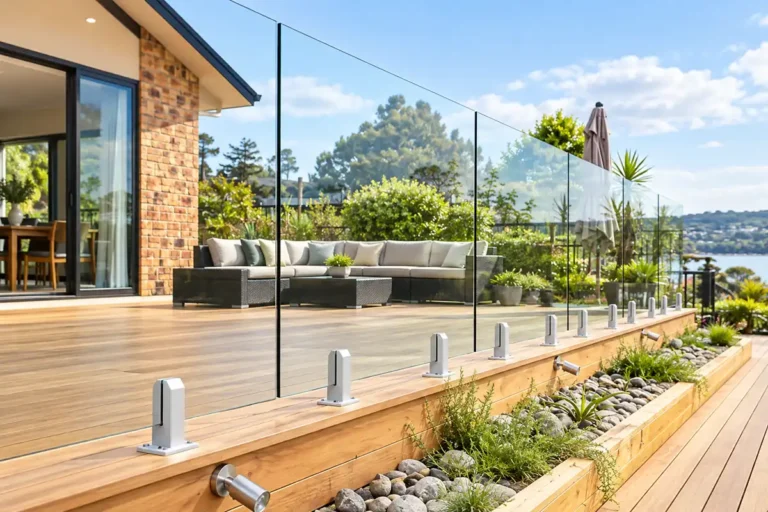
| Glass panels | Open, modern | Balconies, lobbies, views | Glass cleaning; laminated glass may be required |
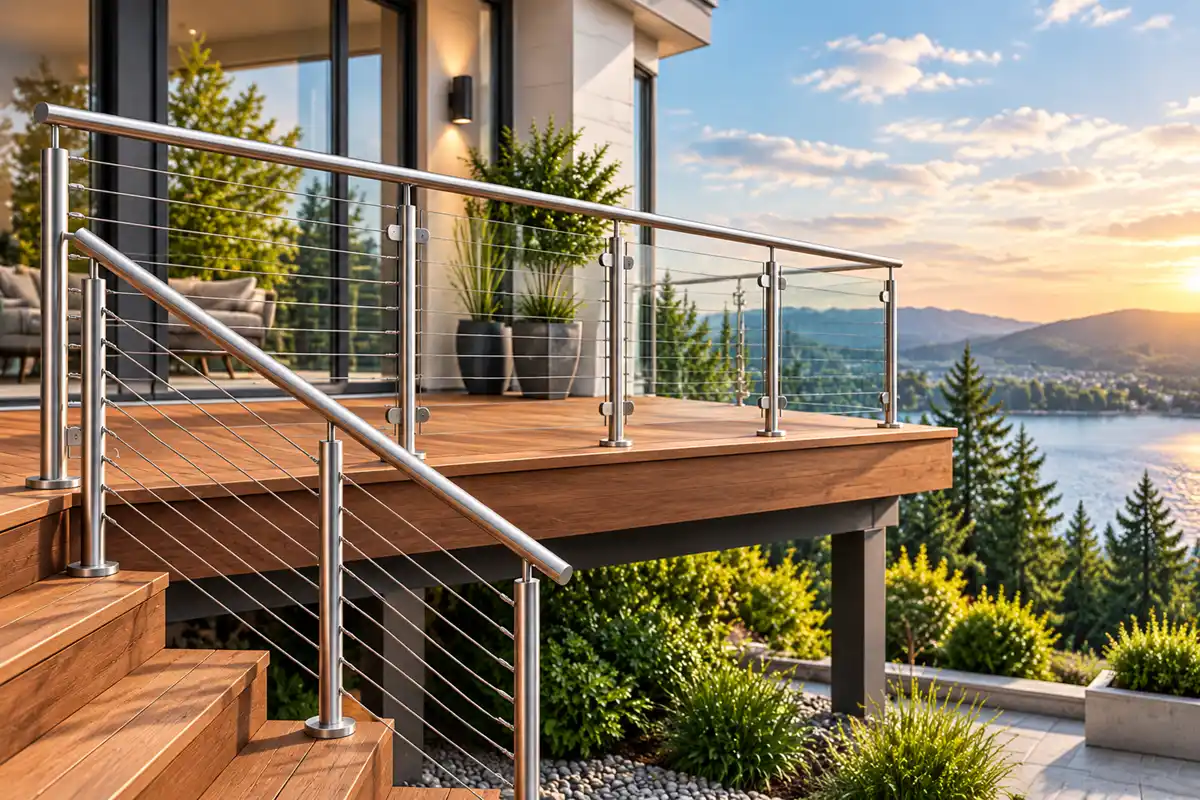
| Cable (wire rope) | Light, minimal | Decks, terraces, stairs | Needs correct tension and spacing to meet opening rules |
| Horizontal or vertical bars | Classic, robust | Commercial, public spaces | Horizontal bars can be climbable, so check local rules |
| Mesh or perforated panels | Industrial, secure | Car parks, plant areas | Heavier and less transparent |
Glass infill is held with glass clamps fixed to the posts. See our guide to glass clamp systems. Cable infill uses tensioners and end fittings, covered in our cable railing hardware guide.
Code Requirements for Stainless Steel Guardrails
Buildings (IBC and IRC)
In the US, the International Building Code generally requires guards at least 42 inches high where there’s a drop of more than 30 inches, and the residential code usually requires 36 inches. Guards must resist a 50 lb/ft uniform load and a 200 lb concentrated load at the top, and openings must stop a 4-inch sphere.
Workplaces (OSHA)
For industrial walking-working surfaces, OSHA 1910.29 requires top rails at 42 inches (±3 inches) that can withstand a 200 lb force, plus mid-rails or equivalent protection below. Industrial guardrails therefore often use heavier posts and a mid-rail, rather than decorative infill.
Other Countries
Australia (AS 1170.1 and NCC), the UK (BS 6180 and Approved Document K) and the EU have their own heights and loads. Commercial guards are commonly 1,000–1,100 mm high. Always confirm your local rules with the building official or engineer.
Choosing the Right Stainless Steel Grade
- 304 stainless steel: the standard grade for dry indoor spaces such as offices, homes and shopping centres.
- 316 stainless steel: contains molybdenum for much better resistance to chlorides. Choose it for exteriors, pools, coastal sites and roads that use de-icing salt.
The World Stainless Association publishes guidance on grade selection by environment, and our full comparison is here: which is better, 304 or 316 stainless steel? For seaside projects, also see the best railing systems for coastal areas.
Welded vs Modular Guardrail Systems
Welded systems are fabricated in a workshop and give seamless joints, but they’re harder to transport and to adjust on site. Modular systems use factory-made fittings (elbows, connectors, brackets and end caps) that assemble with screws. They’re faster to install, easier to ship, and simple to repair. Most contractors now prefer modular systems for balconies, stairs and commercial interiors.
What Drives the Cost of a Stainless Steel Guardrail?
- Stainless steel grade (316 costs more than 304)
- Infill type (glass and cable usually cost more than bars)
- Finish (mirror polish and matte black cost more than satin)
- Post spacing and height, which set how much material is needed
- Curves, stairs and custom angles
- Installation access and the substrate
Maintenance Tips
Wash stainless steel guardrails with mild soapy water and rinse with clean water. Outdoors, near the coast, do this every few weeks. Always wipe in the direction of the polish grain, never use steel wool or chlorine cleaners, and check post fixings once a year. Brown “tea staining” can usually be removed with a stainless steel cleaner, but using 316 in the first place prevents most of it.
Where Stainless Steel Guardrail Systems Are Used
Commercial Buildings
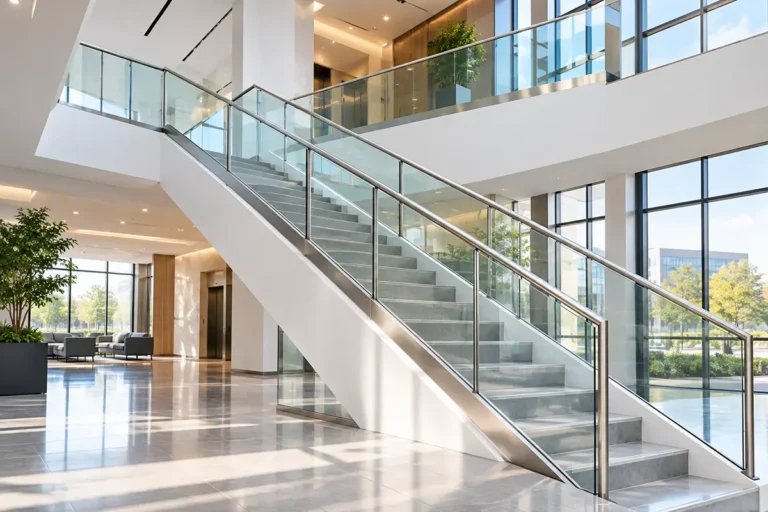
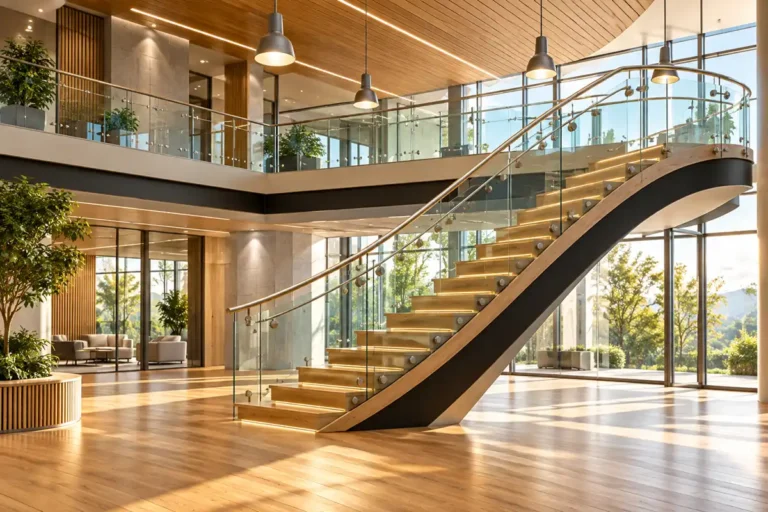
Office mezzanines, shopping centre voids, hotel stairs and airport walkways use stainless steel guardrails because they handle heavy daily use and look professional for decades. Satin 304 is common indoors, often with glass infill for an open feel. For glass-heavy designs, see our guide to commercial glass railing systems.
Residential Balconies and Decks
Homeowners choose stainless steel for a clean, modern look that needs no painting. Cable or glass infill keeps views open, and 316 grade is the safe choice for anything outdoors.
Industrial Platforms and Plant Rooms
Here function comes first. Guardrails follow workplace rules such as OSHA 1910.29, usually with a top rail, a mid-rail and a toe board. Stainless steel is chosen where hygiene or corrosion matters, for example in food processing, pharmaceutical plants and water treatment.
Marine and Waterfront Projects
Marinas, boardwalks, piers and seaside promenades face constant salt spray. 316 stainless steel with a smooth, polished finish, regular fresh-water rinsing, and fittings from a single grade give the best long-term results. Our guide to railing systems for coastal environments covers this in detail.
Public Infrastructure
Bridges, stations, parks and stadiums need guardrails that resist vandalism and weather and are easy to maintain. Robust posts, bar infill and bolt-together fittings that can be replaced individually suit these settings.
Post Spacing and Fixing Methods
Post spacing is usually between about 1.0 m and 1.5 m, depending on the top rail size, infill type and design loads. Cable infill needs closer post spacing or intermediate supports, because tensioned cables pull hard on the end posts. Common fixing methods include:
- Top-mounted base plates: the simplest to install on concrete and steel.
- Side-mounted (fascia) brackets: keep the walking surface clear, and suit balconies and stairs.
- Core-drilled posts: grouted into concrete for the cleanest look and high strength.
- Embedded posts: cast into concrete during construction, used on bridges and heavy-duty public projects.
End posts and corner posts carry the most load, especially with cable infill, so they’re often heavier or braced.
Finishes and Colours
- Satin (No. 4 or brushed): the standard architectural finish, which hides wear well.
- Mirror polish: very smooth and reflective, and it resists corrosion better outdoors because salt and dirt don’t cling.
- Matte black: a modern designer choice for residential and hospitality projects. See our matte black railing systems.
- PVD colours: gold, bronze and other coloured finishes applied by physical vapour deposition, used for luxury interiors.
Design Tips for a Better Guardrail
- Keep the top rail comfortable to hold. A round tube of about 42–50 mm diameter feels natural in the hand.
- Align post positions with floor joints, glass panel joints or structural grid lines for a tidy appearance.
- Use end caps on every open tube end to keep water and dirt out. See our stainless steel end caps.
- Match the guardrail to other metalwork, such as balustrades, canopies and door hardware, in finish and grade.
- On stairs, make sure the handrail runs continuously and extends past the top and bottom steps where the code requires it.
Specification Checklist
- Location and exposure: interior, exterior, coastal or industrial.
- Applicable code: IBC/IRC, OSHA, AS/NCC, BS or local equivalent.
- Guard height, design loads and opening limits.
- Stainless steel grade for all parts, including fixings.
- Post size, spacing and fixing method.
- Infill type and fixing hardware.
- Finish and colour.
- Test data or engineering calculations from the supplier.
Modular vs Fabricated: Cost and Lead Time in Practice
For contractors, the choice between a modular kit and a fully welded, custom-fabricated guardrail often comes down to programme and budget rather than looks.
| Modular (bolt-together fittings) | Custom fabricated (welded) | |
|---|---|---|
| Lead time | Short, because standard parts are often in stock | Longer, because shop drawings, fabrication and polishing come first |
| Site adjustment | Easy, since tubes are cut to fit on site | Limited, so measurements must be exact |
| Transport | Compact cartons, suited to export | Large, fragile sections |
| Repairs | Replace a single fitting | May need on-site welding and re-polishing |
| Appearance | Clean, with visible fittings | Seamless joints |
Many projects use a hybrid: welded posts or sections for complex stair geometry, combined with modular fittings, glass clamps and end caps for the straight runs. This balances a high-end finish with fast installation and easy maintenance.
Source Stainless Steel Guardrail Components From UNIKIM
UNIKIM has manufactured stainless steel railing components for more than 20 years. Our range includes posts, slot tubes, glass clamps, cable fittings, bar holders, brackets, elbows and end caps in 304 and 316 stainless steel, produced under ISO 9001 quality management. We supply fabricators, contractors and distributors, with custom sizes and finishes available. Request a quotation for your project.
FAQs
How high should a stainless steel guardrail be?
In most US commercial buildings, at least 42 inches. In homes it’s often 36 inches, and for OSHA-regulated workplaces it’s 42 inches ±3 inches. Other countries typically require 1,000–1,100 mm for commercial guards.
Is stainless steel better than aluminum for guardrails?
Stainless steel is stronger, more scratch-resistant, and looks more premium, especially in 316 grade outdoors. Aluminum is lighter and cheaper. Our comparison of aluminum vs stainless steel railing systems covers the trade-offs.
Will a stainless steel guardrail rust?
Stainless steel doesn’t rust like carbon steel, but the wrong grade can show brown staining in salty or polluted environments. Using 316 outdoors and cleaning regularly prevents it.
Can stainless steel guardrails be installed without welding?
Yes. Modular systems use bolt-together fittings, including elbows, connectors, post brackets and end caps, so the guardrail can be assembled on site with no welding.
What size stainless steel tube is used for guardrails?
Round posts and top rails of about 42.4 mm (1.66″) or 50.8 mm (2″) diameter are very common, with wall thicknesses selected to meet the design loads. Square systems often use 40×40 mm or 50×50 mm tube.
How far apart should stainless steel guardrail posts be?
Typically about 1.0–1.5 m (3–5 ft), depending on the rail size, infill type and required loads. Cable systems usually need closer spacing or intermediate supports. Your engineer or supplier should confirm the spacing for your project.