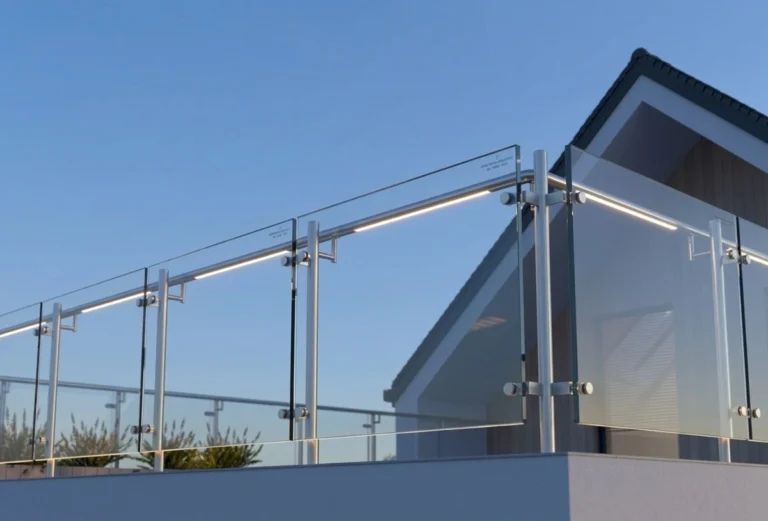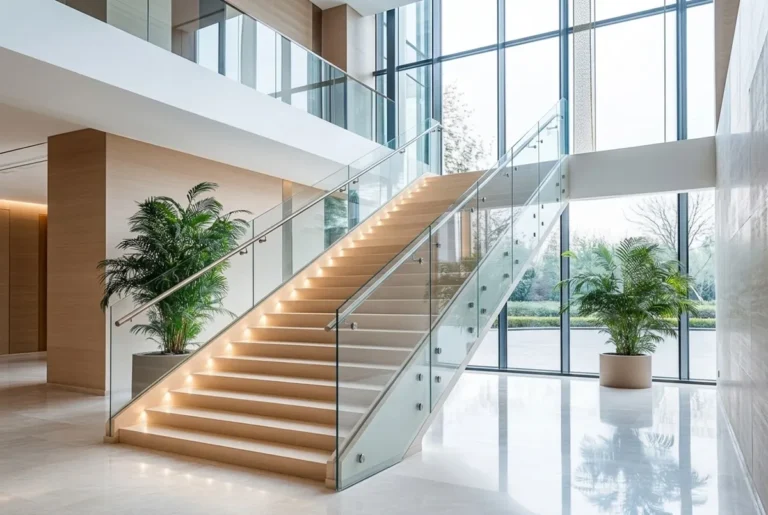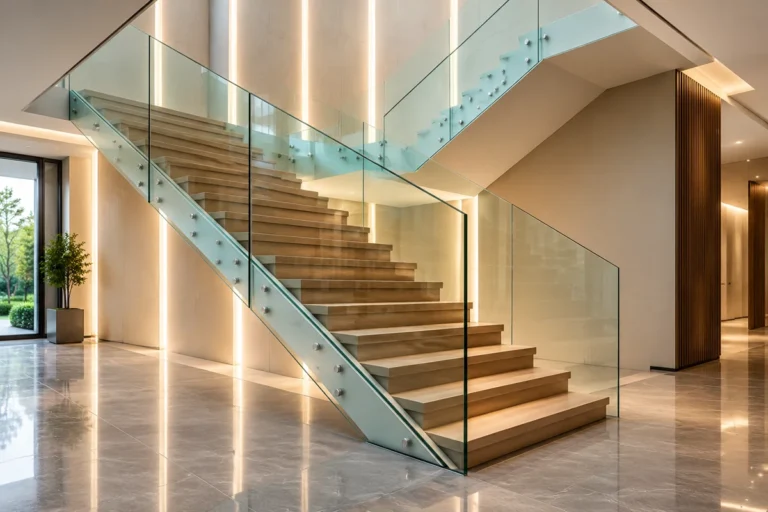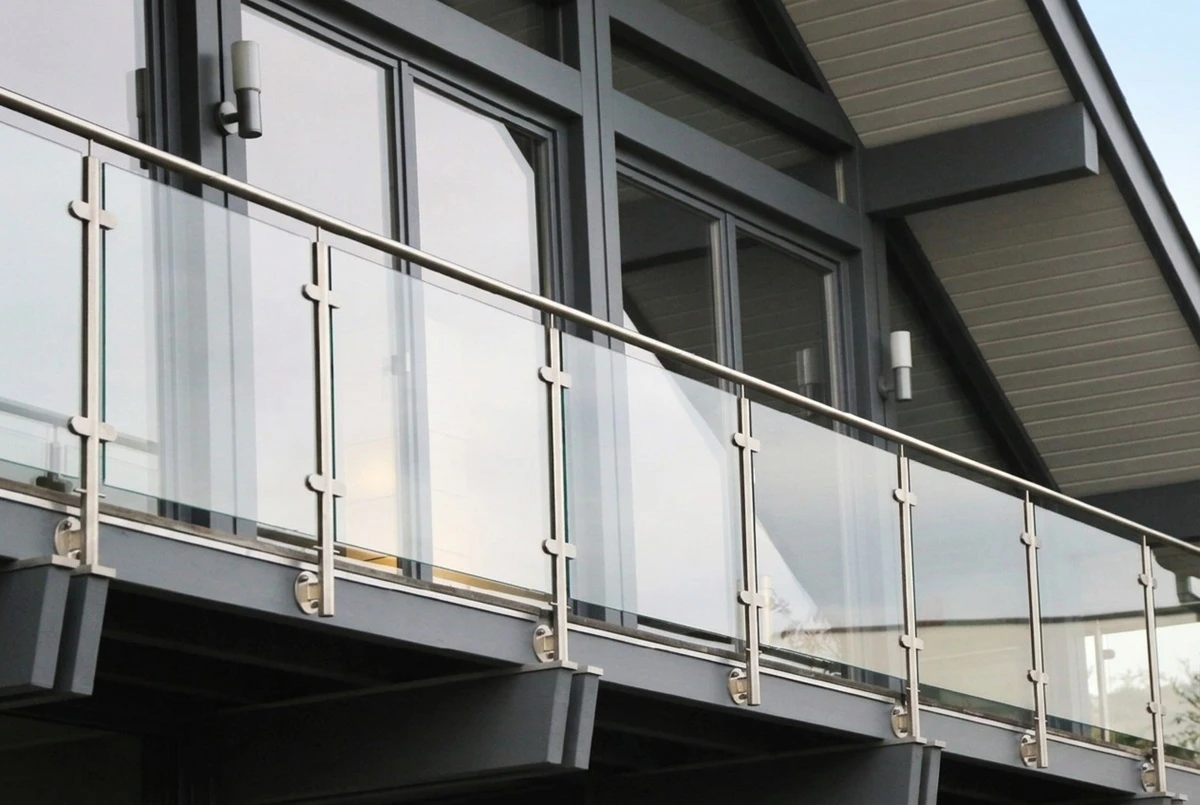
Glass looks delicate, yet a glass guard must stop a person from falling. That is why engineers ask so many questions about loads before they approve a design. Understanding glass railing load requirements helps you choose the right glass, the right hardware and the right fixings from the start.
At UNIKIM, we have manufactured glass railing hardware since 2003, and load questions come up on almost every commercial project. This guide explains guard loads and wind loads in plain English. It also shows how each one affects glass thickness, fixing design and system choice.
Note: This article is general guidance, not a structural design. Every glass railing needs checking by a qualified engineer for its specific site and code.
Glass Railing Load Requirements Explained
Two kinds of load act on a glass railing. Guard loads come from people leaning, pushing or falling against the rail. Wind loads come from air pressure and suction on the glass, which matter most outdoors and at height.
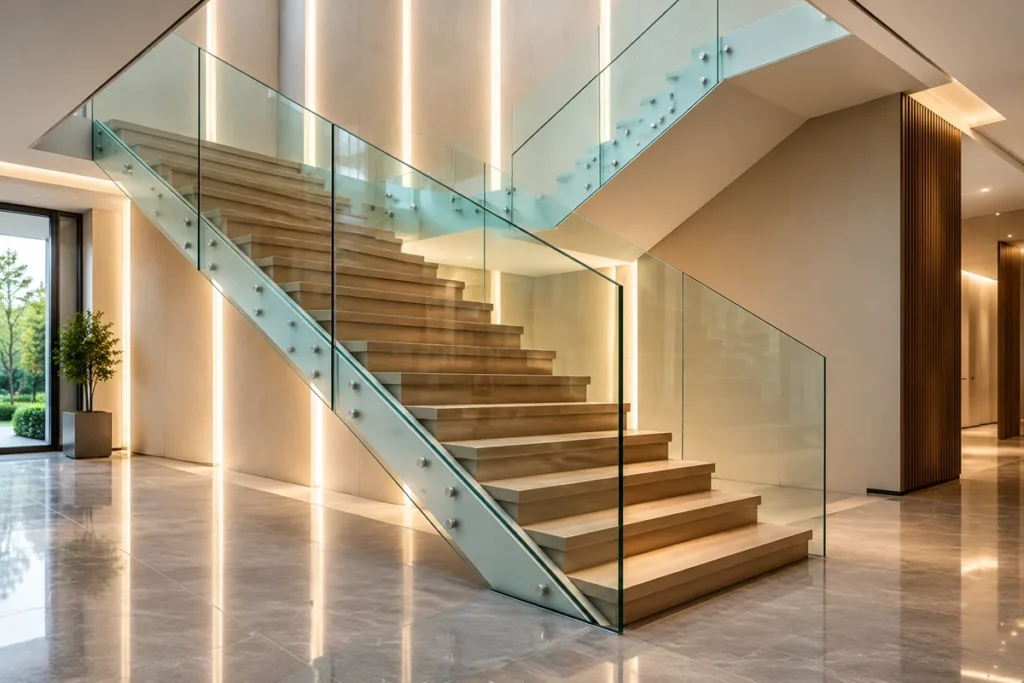
Building codes set the guard loads directly. Wind loads, by contrast, depend on the location, height and exposure of the building. In practice, an engineer checks both and designs for whichever is larger.
| Load type | Where it comes from | Main reference (US) | Where it governs |
|---|---|---|---|
| Concentrated guard load | A person falling against the top | IBC 1607.9 | Homes, low-rise buildings |
| Line guard load | Crowds leaning along the rail | IBC 1607.9 | Commercial, public areas |
| Infill load | Pressure on the panel itself | IBC 1607.9 | All glass panels |
| Wind load | Air pressure and suction | ASCE 7 | High-rise, coastal, exposed sites |
Guard Loads: The Core Glass Railing Load Requirements
In the US, the International Building Code (IBC), Section 1607.9 sets the guard loads. These loads apply to every guard, whatever it is made of.
The 200 lb concentrated load
The top of the guard must resist a single 200 lb (about 0.89 kN) load at any point, in any direction. This represents a person stumbling or falling against the rail. For glass, the worst case is often at a free corner or at the end of a run.
The 50 lb per foot line load
The top must also resist a 50 lb per linear foot (about 0.73 kN/m) load along its length. This represents a crowd leaning on the rail together. Engineers check the two loads separately and do not add them together.
There are two important exceptions. First, one- and two-family homes only need the single 200 lb load. Second, some industrial and storage areas with few occupants can use a lower line load. However, public areas always use the full values.
The infill load
The glass panel itself must resist 50 lb applied over one square foot, horizontally. This checks that a panel does not fail if someone kicks or pushes it in the middle. Solid glass usually handles this easily, but the fixings must still hold it.
The design factor of four
Glass behaves differently from steel. It breaks suddenly, and its strength varies from panel to panel. For that reason, IBC Section 2407 applies a design factor of four to glass in guards. In simple terms, engineers must design the glass so its working stress stays well below the level that could break it.
Wind Loads on Glass Railings
A solid glass guard acts like a small wall in the wind. On a ground-floor deck, guard loads usually govern. On a 20th-floor balcony, however, wind pressure can be much larger than any person leaning on the rail.
Engineers calculate wind loads using ASCE 7, Minimum Design Loads for Buildings and Other Structures. The result depends on wind speed for the region, building height, exposure and the position of the balcony on the facade. Corners and edges of tall buildings often see the highest pressures.
Wind also works in both directions. It can push glass inward and pull it outward through suction. As a result, the fixings must resist both pressure and uplift, and the glass must be stiff enough to limit movement.
When wind governs
Wind loads often govern in three situations. First, high-rise balconies and roof terraces often see strong wind. Second, coastal or open sites have high design wind speeds. Third, tall glass, such as privacy screens or pool barriers, catches more wind.
How Loads Affect Glass Thickness
Load, span and support type decide the glass thickness. A panel fixed along its whole bottom edge in a base shoe behaves very differently from a panel held by two spigots. Point-fixed glass concentrates stress around the fixings, so it often needs thicker glass.
| Support type | How load travels | Typical glass range |
|---|---|---|
| Continuous base shoe | Along the full bottom edge | 17.52–21.52 mm laminated |
| Spigots (2 per panel) | Through two points | 12.76–17.52 mm laminated |
| Standoffs | Through bolted points on the side | 12.76–21.52 mm laminated |
| Posts and clamps | Into posts, then the floor | 10–12.76 mm |
Deflection and comfort
Strength is not the only concern. A glass guard can be strong enough and still flex more than people like. In the UK, for example, BS 6180 sets deflection limits for barriers under load. Many engineers in other markets apply similar limits by choice, because a railing that moves feels unsafe even when it is not.
Stiffer interlayers, thicker glass and continuous support all reduce movement. Therefore, a tall balcony panel may need a heavier build-up for comfort, even if it already passes the strength check.
These ranges are typical, not design values. Your engineer must confirm the exact build-up for each panel size, load and support.
How Hardware Meets Glass Railing Load Requirements
The glass is only one part of the load path. Loads travel from the glass into the hardware, then through the anchors into the structure. If any link is weak, the whole system fails.
Base shoe spreads load along the slab edge, so it handles high line loads and wind well. A continuous aluminum base shoe is the usual choice for tall laminated glass on commercial balconies.
Spigots carry load through two points per panel. Therefore, the spigot base, bolts and substrate must resist high bending. For example, a stainless steel glass spigot needs solid concrete or blocking, never just floor tiles or decking.
Standoffs resist load through bolts in shear and bending. They work well on stairs and slab edges, as long as the edge distance in concrete is sufficient. You can compare options in our glass standoff range.
For a deeper look at fixing strength, read our article on how much load a stainless steel bracket can handle.
Top Rails and Post-Breakage Safety
Codes also consider what happens after a panel breaks. The IBC generally requires structural glass balusters to have an attached top rail or handrail. The exception is approved laminated glass with two or more plies of equal thickness.
A top rail ties panels together, so a broken panel stays connected to its neighbors. Laminated glass, meanwhile, holds its fragments on the interlayer. Stiffer ionoplast interlayers keep more strength after breakage than standard PVB, which is why many engineers prefer them on high balconies.
Testing and Proving Performance
Calculations are the main way to prove a design. Many engineers also rely on physical testing. ASTM E2353 is a standard test method for the performance of glass in railing systems and balustrades.
When you compare suppliers, ask for load data that matches your glass size and fixing type. Also ask whether the data covers the complete system, including anchors. Generic figures for a single part rarely tell the full story. In addition, check the date and edition of any test report, because standards and products both change over time.
Guard Loads Outside the US
Other countries set glass railing load requirements in similar ways, although the numbers differ. In Canada, Part 4 of the National Building Code sets guard loads for engineered buildings. In the UK and much of Europe, loads follow Eurocode EN 1991-1-1, with national annexes and BS 6180 guidance in the UK.
These codes usually link the load to how the space is used. A private balcony carries a lower line load than a shopping mall or a stadium walkway, where crowds can press against the rail. Australia and New Zealand follow AS/NZS 1170.1 in a similar way. As a result, exporters should never assume that a US design automatically meets overseas rules.
Common Load Design Mistakes
We see a few mistakes again and again. The first is designing the glass but ignoring the anchors. A strong spigot on weak concrete, or too close to a slab edge, can still pull out under load.
Another mistake is using indoor calculations for an outdoor balcony. Wind can change the result completely, especially above the first few floors. Similarly, some teams forget that the free end of a run, with no neighbor panel, often sees the highest stress.
Finally, mixing parts from different suppliers makes load data unreliable. Test results only apply to the system that was tested. For consistent performance, choose a complete system, such as a frameless glass balustrade system, and keep every component from the same source. Our guide to glass railing mounting hardware compares the main options.
Glass Railing Load Requirements Checklist
- Confirm the code, occupancy and any local amendments.
- List guard loads: 200 lb point, 50 lb per foot line and infill.
- Check wind loads for exterior and high-rise locations.
- Apply the design factor for glass.
- Choose support type, glass build-up and interlayer.
- Design anchors and substrate for the full load path.
- Confirm top rail or post-breakage requirements.
- Get signed calculations and supporting test data.
Why Work with an Experienced Manufacturer
Load design goes faster when the hardware supplier provides clear product data. UNIKIM has made glass railing hardware in Ningbo since 2003, in AISI 304, 316 and 2205 stainless steel. We supply spigots, standoffs, clamps and base shoe as complete, matched systems for wholesale and OEM projects.
Our commercial railing team works with contractors and engineers to match hardware to project loads. You can also see our products in use on the UNIKIM YouTube channel.
FAQ About Glass Railing Loads
What are the glass railing load requirements under the IBC?
Under the IBC, the top of a commercial guard must resist a 200 lb concentrated load and a 50 lb per foot line load, applied separately in any direction. Infill must resist 50 lb over one square foot. The IBC also applies a design factor of four to glass, which drives most glass railing load requirements.
What does the 200 lb guardrail load mean?
It means the top of the guard must resist a single 200 lb force, about 0.89 kN, applied at any point and in any direction. This represents a person falling or leaning hard against the rail. Together with the line load, it is one of the key glass railing load requirements for homes and commercial buildings.
Do glass railings need to be designed for wind?
Yes, especially outdoors and on tall buildings. Wind can push or pull on solid glass panels, and on upper floors those pressures can exceed the guard loads. Engineers check both sets of glass railing load requirements and design for whichever governs.
Why does glass need a safety factor of four?
Glass breaks suddenly rather than bending first, and its strength varies from panel to panel. A design factor of four keeps working stresses well below the breaking point. That is why glass railing load requirements often lead to thicker glass than people expect.
How do I prove a glass railing meets load requirements?
Most projects use engineering calculations signed by a licensed engineer, often supported by test data. ASTM E2353 is a common test method for glass railing systems. Ask your supplier for load data that matches your glass railing load requirements, glass size and fixing.
Summary
Every glass railing must resist people and, outdoors, the wind. Guard loads come straight from the code, while wind loads depend on the site. Glass adds its own rules, including a design factor of four and post-breakage safety.
The safest designs match the glass, hardware and anchors to the full load path and confirm it with an engineer. If you need hardware that meets your glass railing load requirements, send us your drawings. Contact UNIKIM for product data and a quotation.