The glass gets all the attention, but the hardware underneath it decides whether a glass railing is safe, how it looks, and how hard it is to install. Choose the wrong mounting system and you can end up with glass that doesn’t fit, a substrate that can’t take the load, or a railing that fails inspection.
This guide compares the four main types of glass railing mounting hardware: spigots, standoffs, clamps and base shoes. It explains where each one works best and what to check before you order.
What Does Glass Railing Mounting Hardware Actually Do?
Mounting hardware has two jobs. First, it transfers the load on the glass, such as a person leaning on it or wind pushing against it, into the floor, stair stringer or wall. Second, it holds the glass at the correct height and alignment so the panels form a straight, even line.
Building codes set the minimum load a guard must resist. In the United States, the International Building Code (IBC) requires guards to resist a 50 lb per linear foot load along the top and a 200 lb concentrated load. Other countries use their own standards, such as AS 1170.1 in Australia and BS 6180 in the UK. The hardware you choose, and the way it is fixed, has to meet those numbers for your specific glass height and panel width.
The Four Main Types of Glass Railing Mounting Hardware
1. Spigots (Point-Fixed Posts)
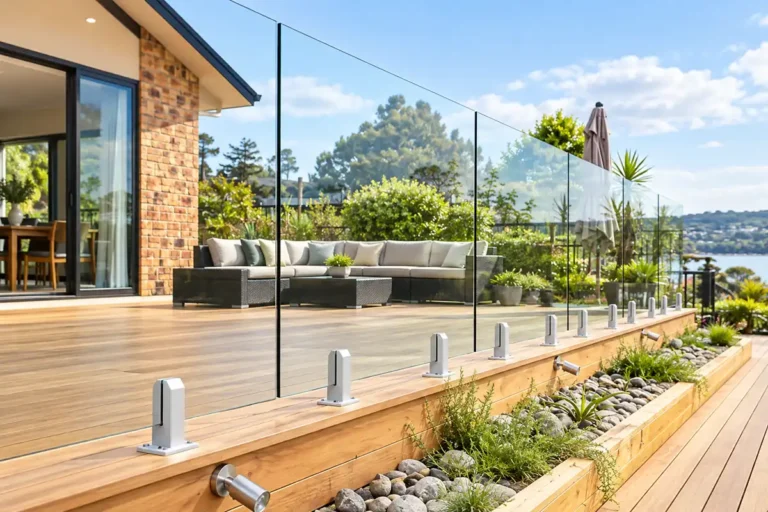
Spigots are short, heavy stainless steel posts that grip the bottom edge of the glass. Most panels use two spigots, and there is no post or rail above the glass, so spigots give the classic “floating glass” look.
- Best for: balconies, decks, terraces and pool fences where you want uninterrupted views.
- Mounting options: base-plate (bolted to the surface), core-drilled (set into holes in concrete) and side-mount (fixed to the face of a slab or stringer).
- Glass: typically 12 mm (1/2″) tempered or 12.76–17.52 mm laminated, depending on the spigot model and local code.
Browse our glass spigots. For pool fences specifically, see our glass pool fence spigot guide.
2. Standoffs
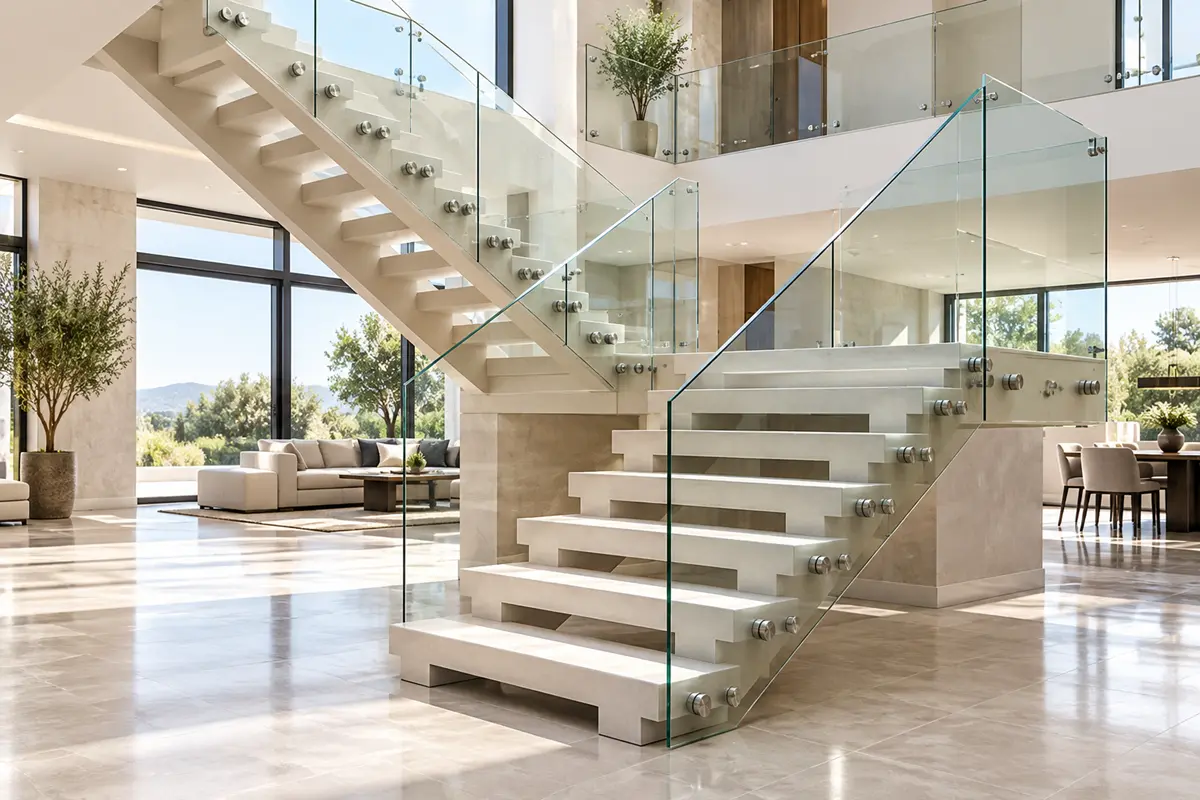
Standoffs are round or square stainless steel pins that fix through holes drilled in the glass, holding it a short distance off a wall, stair stringer or slab edge. Because they mount on the side, they free up the full walking surface, which is a big advantage on narrow stairs and mezzanines.
- Best for: staircases, landings, mezzanines and modern façades.
- Important: the holes must be drilled before the glass is tempered, so your measurements have to be exact.
- Typical layout: two to four standoffs per panel, sized for the glass thickness.
See our glass standoffs and our detailed guide to wall-mounted glass standoffs.
3. Glass Clamps
Glass clamps hold glass infill panels between posts, or connect glass to glass at corners. They grip the glass with rubber gaskets, so the panels usually don’t need drilling. Because the posts carry most of the load, clamps are the most forgiving system for renovation work and uneven surfaces.
- Best for: post-and-glass railings, stair balustrades and budget-conscious projects.
- Glass: commonly 8–12 mm (5/16″–1/2″). Always match the gasket to the glass thickness.
Learn more in our guide to glass clamp systems, or view our glass clamps and connectors.
4. Aluminum Base Shoes (U-Channel)
A base shoe is a continuous aluminum channel that holds the bottom edge of every panel along the whole run. It spreads the load along its full length, so it can support taller or heavier glass and suits high-traffic commercial spaces. With a cladding cover, the channel almost disappears.
- Best for: commercial buildings, long straight runs and projects where engineers want continuous support.
- Glass: often 12–21.52 mm laminated, set with a dry-glaze wedge system or wet-glazed with cement.
Compare base shoe types in our aluminum base shoe guide, or browse aluminum base shoes.
Side-by-Side Comparison
| Hardware | Look | Glass drilling | Load capacity | Install difficulty | Typical use |
|---|---|---|---|---|---|
| Spigots | Frameless, minimal | No | Medium–high | Medium | Balconies, decks, pools |
| Standoffs | Floating, architectural | Yes (before tempering) | Medium | High (precise) | Stairs, mezzanines |
| Glass clamps | Framed by posts | No | Depends on posts | Low | Stairs, renovations |
| Base shoe | Clean continuous line | No | High | Medium–high | Commercial, long runs |
How to Choose the Right Mounting Hardware
Start With the Substrate
The surface you’re fixing into matters more than anything else. Solid concrete can take almost any system. Timber decks usually need blocking or a steel sub-frame under spigots or a base shoe. Hollow block, lightweight screed or thin tiles over a weak base are common failure points, so have them checked before you commit to a frameless system.
Match the Hardware to the Glass
Every clamp, spigot and standoff is designed for a specific glass thickness range. Confirm whether your code requires laminated glass. Recent IBC editions require laminated glass for most glass guard panels (see Chapter 24), which affects the total thickness and the gasket you need. Our comparison of laminated vs tempered glass explains the difference.
Pick the Right Stainless Steel Grade
For indoor projects, 304 stainless steel is usually enough. For anything outdoors, near a pool, or within a few kilometres of the coast, use 316 stainless steel. The molybdenum in 316 resists the chlorides that cause “tea staining” and pitting. Read our full comparison: 304 vs 316 stainless steel, or our guide to railing systems for coastal areas.
Check Whether a Top Rail Is Needed
Some codes require a continuous top rail or handrail on glass guards, either always or when monolithic tempered glass is used. Plan for this early, because it changes the look and the hardware list. Cap rails and handrail fittings are covered in our stainless steel handrail fittings guide.
Think About Installation and Maintenance
Clamp systems are the most forgiving for installers. Standoffs demand precise measuring and pre-drilled glass. Base shoes need accurate levelling, but make glass replacement straightforward with dry-glaze systems. Also ask how the glass can be replaced if a panel ever breaks.
Common Mistakes to Avoid
- Mixing grades: 304 fixings on a 316 railing will stain first and spoil the finish.
- Ignoring edge distance: anchors placed too close to a slab edge can crack the concrete under load.
- Skipping the gaskets: glass must never touch bare metal. Use the rubber or nylon inserts supplied.
- Guessing panel sizes: measure on site after the floor finish is laid, not from drawings alone.
- No engineering check: for commercial projects, ask for load calculations for the exact glass height and spacing.
Understanding Loads: Why Spacing and Anchors Matter
Frameless glass acts like a cantilever. When someone leans on the top edge, the force turns into a large bending moment at the base, where the glass meets the hardware. The taller the glass, the bigger that moment, which is why a 1,100 mm balcony guard needs far stronger fixings than a 900 mm deck railing.
That force has to travel through the hardware and into the structure. Three details decide whether it does:
- Anchor type: chemical (resin) anchors work well in concrete close to edges, while mechanical wedge or sleeve anchors suit thicker slabs with good edge distance. Timber needs through-bolts or structural screws into blocking, never short wood screws into decking boards.
- Embedment depth: the deeper the anchor, the more pull-out resistance it has. Core-drilled spigots rely on grout depth, so follow the manufacturer’s minimum.
- Spacing: closer spigots or standoffs reduce the load on each fixing. Wider spacing looks cleaner but needs thicker glass and stronger hardware.
This is why reputable suppliers publish tested load data for each spigot, base shoe or standoff. A photo in a catalogue tells you nothing about strength, but a test report does.
Glass Thickness Guide by Mounting Type
The table below shows typical ranges only. Your final glass specification should come from the hardware manufacturer’s data and your engineer.
| Mounting type | Typical tempered glass | Typical laminated glass | Notes |
|---|---|---|---|
| Spigots | 12 mm (1/2″) | 13.52–17.52 mm | Check gasket range for laminated build-ups |
| Standoffs | 10–12 mm | 12.76–17.52 mm | Holes drilled before tempering |
| Glass clamps (with posts) | 8–12 mm | 8.76–12.76 mm | Posts carry most of the load |
| Base shoe | 12–15 mm | 12.76–21.52 mm | Supports taller, heavier panels |
Indoor vs Outdoor Hardware Selection
Indoors, the main concerns are appearance, fingerprints and cost. 304 stainless steel in a satin finish is the usual choice, and standoffs or recessed base shoes are popular because they keep stairs and landings uncluttered.
Outdoors, corrosion and weather come first. Choose 316 stainless steel for every visible part and every fixing, leave drainage paths so water doesn’t sit in base shoes, and use UV-stable gaskets. On balconies over living spaces, coordinate with the waterproofing contractor so anchor holes don’t puncture the membrane without proper sealing.
Finishes and How They Age
- Satin (brushed): the most forgiving finish. Small scratches blend into the grain, and it’s easy to clean.
- Mirror polish: the most striking look, and also the smoothest surface, which helps corrosion resistance outdoors. Scratches and fingerprints show more easily.
- Matte black: a strong architectural statement that pairs well with black window frames. See our matte black glass railing systems.
Whatever finish you choose, order spare caps and screws in the same finish so future repairs match.
Planning Checklist Before You Order Hardware
- Confirm the local code: guard height, loads, glass type and whether a top rail is required.
- Identify the substrate at every mounting point, including concrete, timber, steel or stone over screed.
- Choose the mounting system based on look, floor space and load.
- Choose the stainless steel grade and finish for the environment.
- Get tested load data and, for commercial work, engineering calculations.
- Fix the hardware first, then measure the glass on site.
- Order gaskets, setting blocks, caps and spare parts with the main order.
Sourcing Glass Railing Hardware From a Manufacturer
UNIKIM has manufactured stainless steel railing hardware for more than 20 years. We produce spigots, standoffs, clamps, base shoes, posts and fittings in 304 and 316 stainless steel, in satin, mirror, matte black and custom finishes, under ISO 9001 quality management. Contractors and distributors can order standard items or custom sizes for a specific project. Contact our team with your drawings for a quotation.
FAQs
What is the strongest glass railing mounting system?
A continuous aluminum base shoe usually offers the highest load capacity, because it supports the glass along its full length. Heavy-duty core-drilled spigots in concrete also perform very well. The right choice depends on your glass height, span and substrate.
Do I need to drill holes in the glass for a glass railing?
Only for standoff systems and some clamp designs. Spigots, most glass clamps and base shoes grip the glass without holes. If holes are needed, they must be drilled before the glass is tempered.
Can glass railing hardware be installed on a timber deck?
Yes, but the deck framing must be strong enough. Spigots and base shoes on timber usually need extra blocking, or a steel plate that spreads the load across several joists. Ask your engineer or supplier for a fixing detail.
Which stainless steel is best for outdoor glass railing hardware?
316 stainless steel. It contains molybdenum, which greatly improves resistance to salt, pool chemicals and rain, so it’s the standard choice for exterior and coastal installations.
How far apart should glass railing spigots be?
Spacing depends on the glass thickness, panel height and the spigot’s tested capacity. Many residential systems use two spigots per panel, placed roughly 200–300 mm in from each edge. Always follow the manufacturer’s data rather than a general rule.
What is the difference between dry-glaze and wet-glaze base shoes?
Dry-glaze base shoes lock the glass in place with mechanical wedges or tapers, so panels can be adjusted or replaced later. Wet-glaze systems set the glass in grout or cement, which is permanent and harder to repair. Most modern projects use dry-glaze systems.